

Ray had his knee replaced two years ago and he still does this thing where he rocks forward three times before he stands up. The third rock is the one that works. If it does not, he sits back down and pretends he meant to stay there. I spent twenty-four years as a home health aide, most of it in other people's living rooms, helping men and women older than me get out of chairs. So when a neighbor calls and asks whether her mother needs a stand assist rail or a lift chair, I know what she is really asking. Is a rail enough, or do we have to buy the motor?
Here is the answer I give. If the person can finish a stand once they have something solid to push against, a rail like the Vive Stand Assist will do the job, and it will do it on the couch they already own. If the legs cannot finish the stand even with a bar to grab, or if the hips will not let them get to the edge of the seat in the first place, you need the motor. Those are two different problems. They get two different answers, and I wish more salespeople would say so out loud.
| Vive Stand Assist | Lift Chair | |
|---|---|---|
| What it does | Gives you a solid bar to push down on so your own arms and legs do the standing | The seat tilts and rises under you, and the chair carries a share of the lifting |
| Portability | 2.7 pounds, lifts off the couch and goes in the car | Furniture. It stays where it is plugged in |
| Floor space | Slides in beside the cushion and adds nothing to the room | Needs clearance behind it to recline and a wall within reach of an outlet |
| Power needed | None | Has to stay plugged in, though many models include a battery backup |
| Weight capacity | 300 pounds, per the listing | Varies a great deal by model, so read the label before you buy |
| Reclining and napping | Does nothing for the chair itself | Reclines, which matters if the chair is also where they sleep |
| Works with the furniture they own | Fits around the base of a secure cushion or under a loose one on a couch, sofa, or recliner | Is the furniture, so whatever it replaces has to leave |
| Setup | Unfold and slide it into place | Delivery, assembly, and a spot near an outlet |
| Warranty | Lifetime guarantee from Vive | Usually a few years on the motor, and it varies by maker |
| Best for | Someone who can stand with a little help and wants to keep their own couch | Someone who cannot stand from a low seat even with help |
Two Different Kinds of Help
People lump these together because both get sold as help getting up. They are not the same kind of help. A rail is leverage. You set your hand on it, you push down, and your own arms and legs do the standing. It is the same thing I used to offer clients when I held out my forearm, except the rail never gets tired and it never has to leave the room. A lift chair is power. The seat tips and rises under you, and the chair carries a share of the weight your legs used to carry.
That one difference decides everything else. It decides how much floor space the thing takes, what happens when the power goes out, whether the person can still sit in the front room with the family on a Sunday, and whether you are adding to the furniture or replacing it. I have seen both work well. I have also seen a lift chair sit in a garage because it would not fit through a door, and I have seen a rail save a man a great deal of money and a little bit of dignity at the same time.

Where Vive Wins
The Vive Stand Assist weighs 2.7 pounds. I can pick it up with two fingers and carry it from the living room to the car, which means it goes to church, to our daughter's house at Thanksgiving, and to the recliner at the lake. It is aluminum, it is rated to 300 pounds, and it fits around the base of a secure cushion or under a loose one, so it works on a couch, a sofa, or a recliner you already have. Nothing about it needs an outlet, a delivery crew, or an instruction sheet longer than a page.
The other thing I like is that it is adjustable. Ray is 5 foot 11 and broad through the shoulders. I am 5 foot 3 with a stiff lower back in the mornings. We can both use the same rail because the height moves. When he had his knee done we kept one on the couch and one on the bed, and neither one changed the look of the room. If your mother is fiercely attached to her own furniture, and most of the women I worked with were, that counts for more than any feature list.
Where a Lift Chair Wins
Now the honest part. A rail only helps after the person has scooted to the edge of the seat. If the hips or the knees will not let her scoot, the rail is a bar she holds while she stays exactly where she is. I have watched that happen and it is a hard thing to watch. A lift chair does the part the rail cannot do. It tilts the seat forward and raises it, so she is standing before she has to ask much of anything from her legs.
A lift chair also reclines, and that is not a small thing. Plenty of the people I cared for slept in their chair more nights than they slept in bed, either because lying flat was uncomfortable or because getting up in the dark frightened them. A rail does nothing for that. So if you are choosing one piece of furniture to be the chair, the bed, and the reading spot for the next several years, the lift chair is the more complete answer and I will not pretend otherwise.
If She Can Stand Once She Has a Bar, Start With the Rail
The Vive Stand Assist weighs 2.7 pounds, holds up to 300, and slides in beside the cushion on the couch she already owns. No outlet, no delivery, no assembly.
Amazon Check Today's Price on Amazon →What the Listing Actually Tells You
I read listings for a living now, or at least for a hobby, and the Vive listing is refreshingly short on poetry. Aluminum frame. 2.7 pounds. Rated to 300 pounds. Adjustable. Wipes clean with a damp cloth. Comes with a lifetime guarantee. The base is listed at 19.25 by 9 inches and the grab height at about 12 inches. That is the entire product, and for once the entire product is the point.
Two of those numbers matter to me. The 2.7 pounds is why it gets used. A heavy aid that lives in the closet is worse than no aid at all, and I have hauled enough of them out of closets to know. The 300 pounds is an honest ceiling. Ray is a big man and nowhere near it, but if the person using it is close to that number, or if two people are going to lean on it at once, be careful. It is a lever, not a lift.
What the listing cannot tell you is how it will sit on your particular couch. A very soft cushion will swallow the base and the rail will lean. A very deep seat puts the bar behind the hand instead of beside it. Take the measurements, then go sit on the couch and measure again, because cushions lie. That is the sort of thing I do in my own house and I am not embarrassed about it.
Two and seven tenths pounds of aluminum, rated to 300, and it slips under a cushion you already own. That is the whole argument, and it is a good one.
How I Test Both in a Small Living Room
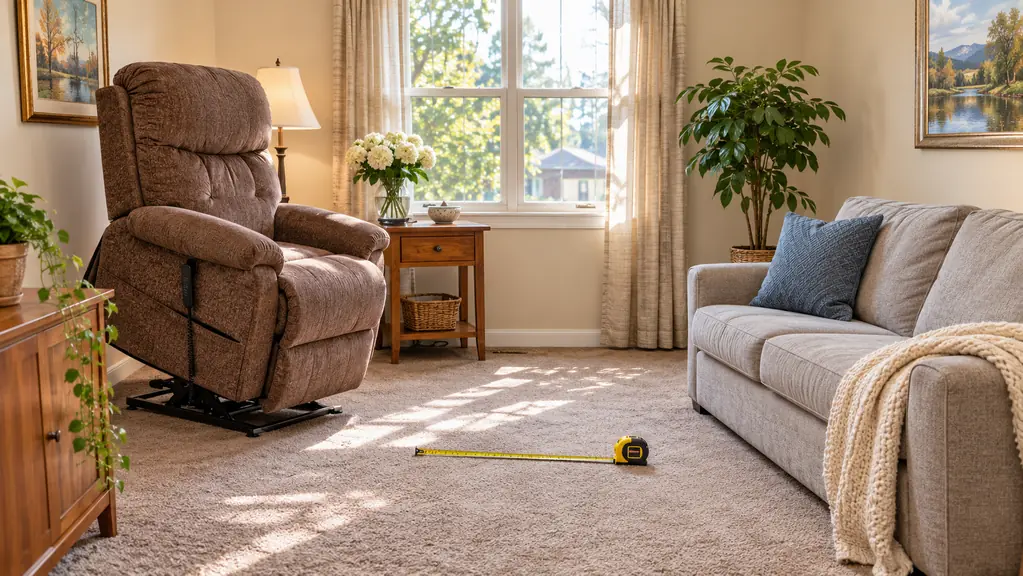
Our living room is about 12 by 14 feet with carpet over a concrete slab, and there is one outlet behind where the recliners sit. That outlet is the reason I am picky. A lift chair has to be near power, which sounds obvious until you are standing in a room where the only free wall is the one with the front door in it. I have moved a recliner twice just to find out where a chair could actually live, and one of those spots would have blocked the walkway to the kitchen.
Then there is delivery. Our front door is 32 inches wide and there is a turn in the hallway that has embarrassed more than one delivery crew. A lift chair arrives in pieces and gets put together where it will stay, and the old couch has to leave the same day or you will be stepping around it for a month. The rail comes in a box the size of a walking stick. I opened ours at the kitchen table and had it on the couch before Ray finished his coffee.
The Part People Forget to Plan For
I am not going to quote you a number, because what these things cost moves around week to week and by where you live. What I will say is that the rail is a fraction of the chair, and that the chair carries costs the tag does not show. There is the delivery, the assembly, the hauling away of whatever it replaces, and the outlet. There is also the plain fact that a lift chair is furniture, and if it does not suit the room, some people will not have it no matter how much they need it.
I have seen families buy the chair first and the rail second, which is the wrong order if you ask me. Buy the smaller, cheaper thing that solves the smaller problem and live with it for a month. If she is standing up on her own by the third week, you are done. If she is still rocking three times and sitting back down, you will know exactly what you are buying the lift chair for, and you will spend the money with your eyes open instead of out of panic after a bad night.
Three Questions I Ask Before Recommending Either
First, can she get to the edge of the seat on her own? Sit in the chair, do not hover above it. If she can scoot forward until her feet are flat and her nose is over her toes, a rail will finish the job. If she cannot, nothing you set in front of her will fix the last six inches. This is the single most useful thing I learned in twenty-four years of this work, and it takes about fifteen seconds to check.
Second, how low is the seat? A rail gives you a fixed place to push, but the lower the seat, the more of the work your legs still have to do. Measure from the floor to the top of the cushion. Anything under about 18 inches is low for most people, and a firm cushion topper is a cheaper fix than a new chair. Third, who else is in the house? If a spouse is going to lean on the rail too, mind the 300 pound rating and mind it honestly.
Who Should Buy Which
Buy the Vive Stand Assist if the person can stand once there is something to hold. That covers more people than you would think: the knee replacement at week six, the hip that is stiff until noon, the bad back that makes a low couch a trap, the man who is fine on a firm chair and stuck on a soft one. Buy it if they want to keep their own furniture, if the room is small, if there is no outlet within reach, or if they move between two houses. Buy two if there are two couches and you can spare it.
Buy the lift chair if the legs cannot finish the stand even with a bar to pull on, if the hips will not let them scoot forward, or if the chair is going to be the place they sleep. Buy it if a therapist or a doctor has said so in plain words. And if you do buy the chair, buy it from someone who will bring it in, set it up, and take the old one away, because that service is worth more than the difference in the sticker and it is the difference between a chair that gets used and one that sits in the garage.
Start With the 2.7-Pound Answer
If she can stand once she has a bar within reach, the Vive Stand Assist handles it on the couch she already owns, for a fraction of what the motor costs. Lifetime guarantee, wipes clean, goes in the car.
Amazon Check Today's Price on Amazon →