

The first time Ray tried to get up from the low armchair in our living room, he did the thing I had seen a hundred times in other people's houses: rocked forward twice, reached for nothing in particular, and sat back down. He had his knee replaced a couple of years ago, and the chair we bought after that surgery looked fine in the store and turned out to sit about two inches too low once it was in our living room. That is how a Vive Stand Assist ended up under that chair's cushion. I have used it daily with Ray for months now, and this is what living with it actually looks like, including the parts I did not expect.
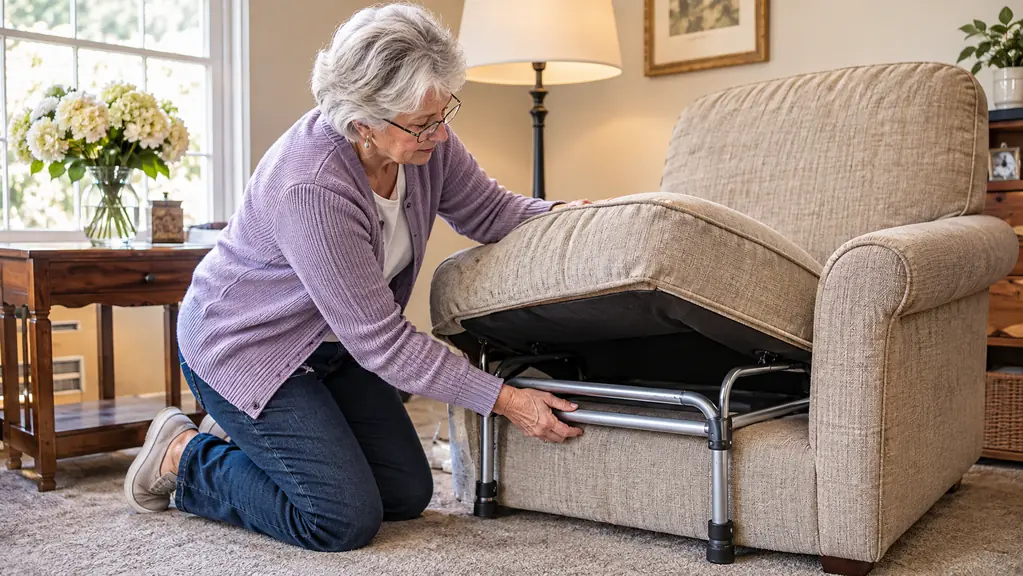
Let me be clear about what this is before anything else. The Vive Stand Assist is an aluminum frame that tucks under a chair or sofa cushion, with a rail that comes up above the seat where your hand can find it. It is not a lift chair. It is not a powered recliner. It will not stand you up on its own. What it gives you is something solid at hip height to push against while you do the work of standing. That distinction matters, because those two products solve the same problem for very different people, and I have watched families buy the wrong one and be out a great deal of money for it.
The Quick Verdict
A light aluminum rail that turned a chair Ray already liked into one he can leave without help. It is only as good as the cushion above it and it is not a lift chair, but for the everyday problem it fixes, it earns its place.
Amazon Check Today's Price →Keep the chair. Lose the two failed attempts before you are on your feet.
The Vive Stand Assist slips under the cushion in about five minutes. Rated to 300 pounds, backed by a lifetime guarantee, and 2.7 pounds when you want it in a different room.
Amazon Check Today's Price on Amazon →How I've Used It
I spent twenty-four years as a home health aide, most of it in other people's living rooms, helping people get out of chairs and beds without going down. Ray and I live in a single-story brick ranch outside Knoxville now. The living room is about twelve by fourteen feet, carpet over a concrete slab, with one wall outlet behind the recliners that we both pretend we are not competing for. Ray is five foot eleven with broad shoulders and a knee that is fine on flat ground and unreliable after twenty minutes in a chair.
I installed it under the armchair first, the low one that caused the rocking. The way it works is the way the listing describes: you lift the cushion, set the frame around the base of the cushion so it sits secure, and put the cushion back down. It took me under five minutes and I did it by myself, which is the only test that matters for a product like this.
Then I moved it. Sofa for a week, then the recliner, then back to the armchair where it has stayed. At 2.7 pounds it moves in one hand and there is nothing to unhook or fold. Ray reaches for it now without looking, which is the highest compliment I can pay a piece of equipment. When something is working, nobody mentions it.
The recliner week taught me the most. That chair has a deep seat and a cushion I would call medium firm, and the frame needed a different setting than the armchair did, a good inch further forward so Ray's hand landed on the rail before he started leaning. I did that on a Sunday morning with a tape measure, marked the setting with a strip of masking tape, and left it. It has not moved since. That is the whole adjustment job, and it is worth doing slowly, because a rail set too far back means you lean forward to reach it and give away the very thing it is supposed to protect.
I want to be honest about the shape of the problem, too. Ray's knee is not a crisis. It is a daily annoyance that produces two or three ugly moments a day, and ugly moments are how falls start. If your situation is bigger than that, this rail is a small tool and I will tell you plainly below when it is the wrong one.

What the Vive Stand Assist Actually Is
One aluminum frame, a rail that comes up above the seat surface, and that is the whole product. The listing gives the height as twelve inches and the width across as twenty-two and a quarter, and the manufacturer rates it to support 300 pounds. Ray is a big man and I am not a small one, and the frame has not flexed or complained once.
The frame is adjustable, which sounds like a line on a box and is not. Every chair has a different cushion depth, and the rail needs to sit close enough to the front edge that your hand lands on it without you leaning forward first. Leaning forward is the exact motion we are trying to make safer. I adjusted mine three times over the first week before Ray's hand found the rail without hunting for it.
Care is a damp cloth. That is the entire maintenance routine. No fabric cover to launder, no battery, no charger, nothing to plug into that single outlet behind the recliners. After twenty-four years of watching gadgets in clients' homes get abandoned because they were a chore to keep up, I notice this more than I used to.
Months In: What Held Up and What Didn't
The frame has not shifted. Not once. That was my main worry going in, because I have seen rails work loose when someone puts real weight on them, and a rail that moves is worse than no rail at all. This one sits under the cushion, so the cushion is what holds it steady, and when Ray pushes down to stand the whole assembly stays where it was put.
The cushion matters more than the rail. On the armchair the cushion is thick and firm and the result is genuinely solid. When I moved the same rail to the sofa, whose cushion is thinner and looser, the setup felt vague, and Ray said so before I did. Same product, different chair, different answer. That is true of every rail in this category and it is the single thing I would want you to check before you order.
What changed over the months is that it disappeared. Around the second month I stopped noticing it as equipment. Ray reaches for it on the way up the way you reach for a stair rail you have used for years, without deciding to. That sounds like a small thing. It is the whole point.
There was a Tuesday in early spring when it proved itself without either of us noticing. I was in the kitchen and heard the chair creak, and by the time I came around the corner Ray was already up and heading for the hallway. He had not called for me. He had not needed to. For twenty-four years my work was being the thing people pushed against, and I will tell you honestly that being unnecessary in my own living room took some getting used to. I wiped the frame down with a damp cloth that afternoon, which is the entire maintenance this thing has asked of me in all these months.
Where It Works in a Real House
It works best on a chair with a firm cushion and a solid deck underneath, the kind where you can lift the cushion off and see the frame of the seat. Recliners usually qualify. Sofas often do not, because the cushions are loose and the deck is soft. If the cushion is sewn in or the seat is one continuous piece, this is not the product for that chair.
Our armchair qualifies, and I can tell you exactly why. Once the cushion comes off you can see the seat deck, and the cushion that goes back on top of it is about four inches thick and firm enough to hold its shape when you press a palm into it. The rail ends up standing proud of that cushion surface, close enough to the front edge that Ray's hand finds it at hip height without reaching. Any chair where those two sentences are true will work. Any chair where they are not, will not, no matter how carefully you adjust the frame.
It also does not fix a seat that is too low. This is the part I want to be blunt about. The rail gives you a handle. If the chair sits so low that your knees end up above your hips, you will still have a hard time standing, and you will be pushing on a rail from a bad position. Two inches of seat height corrected with a firm cushion topper did more for Ray than the rail did, and I would have told you that for free.
Where it shines is the chair someone already loves. Ray likes that armchair. He picked it out. Replacing it with a lift chair would have cost considerably more and would have meant giving up the chair he wanted, and I have watched people resist a good solution purely because it came attached to furniture they did not choose. This rail lets the chair stay.
The Tradeoffs Nobody Mentions
You cannot leave it in permanently and forget the chair is different. It occupies the seat. When our daughter visits, someone sits in the other chair, because the rail is where a hip would go. That is not a dealbreaker, but it is a fact of living with it.
The guest problem is smaller than it sounds, though. Our daughter came up from Maryville for a weekend in the fall and we simply moved the rail to the recliner for those two days, which took one hand and about ten seconds. Where it does not travel easily is in a car or a suitcase, not because of the weight but because of the width across. If you are buying this to take to appointments or to a daughter's house, measure the bag first and be realistic about it.
It is also not a lift chair, and it will not become one. It gives you something to push against. It does not give you balance, it does not give you grip strength, and it will not stop a fall if your legs give out on the way up. If the problem is strength rather than leverage, a powered lift chair is the honest answer and I say that as someone who would rather recommend the small thing.
And there is a learning period. Ray pushed on it wrong for the first several days, reaching with his far hand and twisting. I had to stand there and say, near hand, push down, lean forward. That is not a flaw in the rail. It is how any new aid works, and it is worth ten minutes of your attention.
How It Compares to the Alternatives
The obvious alternative is a lift chair, and the honest comparison is longer than one paragraph. A lift chair is powered, it does the standing for you, and it costs many times what this rail costs at today's price. It also replaces your furniture and takes up more floor space in a room that may not have it. This Vive rail adds nothing to the footprint. If you are weighing the two, I laid the whole comparison out separately, and the short version is that they serve different stages of the same problem.
The other thing I get asked about is whether a rail like this is worth it when a cane or a walker is already in the house. Different job. A cane helps you once you are upright. This helps you get upright. Ray uses both, and neither one substitutes for the other.
What I Liked
- Sits under the cushion, so it does not tip or slide when you push down on it
- 2.7 pounds, so it moves from the sofa to the recliner in one hand
- Rated to 300 pounds and the aluminum frame has taken Ray's full weight for months without complaint
- Adjustable frame fits different cushion depths, which is the difference between a rail you reach for and one you hunt for
- Backed by a lifetime guarantee from Vive
Where It Falls Short
- Only as good as the cushion above it. Loose, soft cushions make it feel vague
- Not a lift chair. It gives you something to push against, not a motor
- It stays in the chair, so guests sit somewhere else
- Getting the adjustment right took me three tries over the first week
Around the second month I stopped noticing it as equipment. That is the whole job of an aid: it should stop being one.
Who This Is For
This is for someone who can stand but has to work at it, usually from a low or soft chair, and who has a chair they would rather keep. It is for the grown children shopping for a parent who insists the furniture is fine and the standing is fine, because it is a small enough change that the parent will actually accept it. It is for a house recovering from a knee or hip replacement where the chair at home turned out to be lower than the chair in the therapy room. And it is for a caregiver who is tired of being the thing the person pushes against.
Who Should Skip It
Skip it if the person cannot stand without hands-on help, because a rail is not a person. Skip it if the cushion is sewn in, if the seat is so deep that the rail sits far behind the knees, or if seat height is the real culprit and a lift chair or a different chair is the actual fix. Skip it if the plan is to lean on it hard from the side, since that is not what it is built to do. And skip it if you want a motorized answer, because this is not that and no amount of adjusting will make it that.
Two inches too low at home is still two inches too low. Fix the getting up first.
Vive rates the frame to 300 pounds and backs it with a lifetime guarantee. It fits under secure or loose cushions and comes back out in seconds when you need it in another room.
Amazon Check Today's Price on Amazon →