

Ray turned seventy-three this spring, and for about a year before that, the recliner in our living room had stopped being a chair he could get out of on his own. He would rock forward twice, put both hands flat on the arms, and stall. Then he would look over at me. I knew that look. I spent twenty-four years as a home health aide, much of it in Knoxville living rooms helping people move from a chair to a standing position, and I have seen it on a hundred faces. What finally got him out of that chair was a 2.7-pound aluminum rail called the Vive Stand Assist, and it took me three tries to land on it.
The chair was not really the problem. Ray is five foot eleven with broad shoulders, and since his knee replacement a couple of years back, a low seat with a soft cushion asks more of that knee than it wants to give. He is a retired machinist. He does not ask for help well. For a while he did not ask at all, he just stopped sitting in that chair, which meant he stopped sitting in the room where I sit.
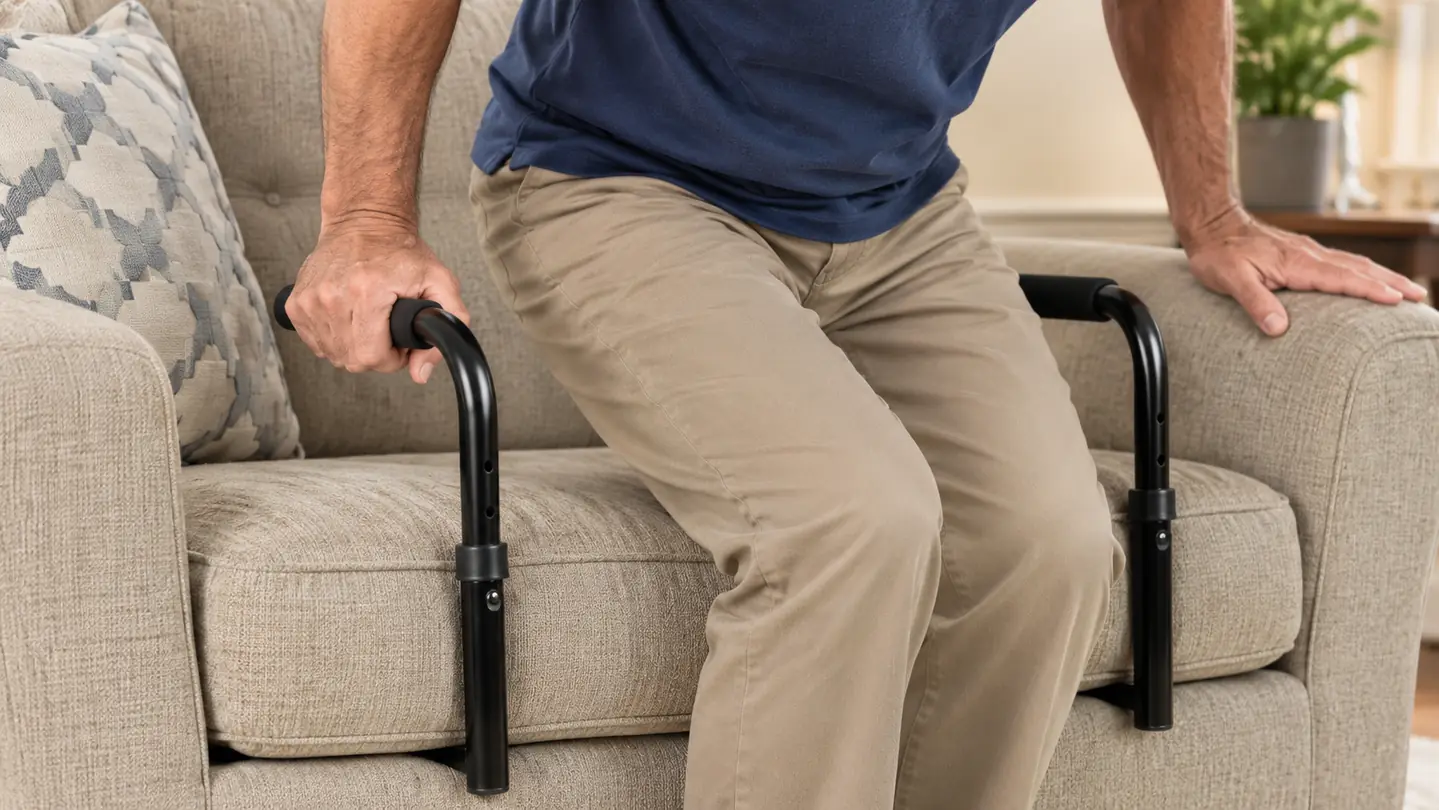
So we worked through the usual list. A cushion booster that slid forward every time he pushed off it. A grab bar on the wall, which meant drilling into the brick and putting his hand somewhere behind his hip instead of out in front where his body actually goes. For a few months I stood and pulled him up by the forearm, which is exactly how aides wreck their own backs, and I know better than that.
The Vive Stand Assist was the third thing we tried and the first thing that stayed. It is a rail, not a lift, and that distinction matters more than anything else I can tell you here.
The Vive rail fits around the base of a secure cushion or tucks under a loose one, so the frame sits close against the seat instead of floating out in the middle of the floor where somebody will trip on it. The frame is aluminum and the listing rates it to three hundred pounds. Ray is nowhere near that number, but I like knowing it is there.
It adjusts, and it is light enough at 2.7 pounds that I can move it from the recliner to the kitchen chair with one hand when he wants to sit at the table. Wipe it with a damp cloth and you are done. In a twelve by fourteen living room with carpet over a concrete slab, that weight matters, because anything heavy enough to be a nuisance is a thing I will stop moving.
The rail does not stand Ray up. It gives him something in front of him to pull against, which was the one part of standing his knee could not do by itself.
The Rail That Lives Beside Ray's Recliner
Aluminum frame rated to 300 pounds, 2.7 pounds to carry, adjusts to fit around a secure cushion or under a loose one. It is the third thing we tried and the only one still in the room.
Amazon Check Today's Price on Amazon →The first week was awkward. He pulled too hard, the way a man does, and the cushion shifted under him. I sat down and showed him the thing I used to show clients: lean forward until your nose is over your knees, then push down on the rail and stand up through it. Slow. By the end of that week he was getting out of the chair without the pause, and by the end of the month he was back to reading in it every afternoon.

Here is what the Vive rail will not do. It will not lift you. It does not recline, it does not tip you forward, and it does nothing at all for getting out of bed. If the cushion underneath is very soft and very loose, it will not anchor well, and you should look at the seat before you blame the rail. It is a fixed point in front of you and nothing more, and for Ray that was enough.
It also took me a few tries to get the placement right. Too far forward and he was reaching. Too far back and it was in his lap. I measured nothing, I just moved it an inch at a time over two evenings until the grip landed where his hands naturally go. The front door here is thirty-two inches and the rail comes through it without a fuss, which matters if you are taking it to a doctor's appointment or to a daughter's house for the weekend.
The one wall outlet is behind the recliners, and I will admit I was braced for a cord. There is no cord. That sounds like a small thing until you have spent a week in a house where every helpful object needs to be plugged in.
What I'd Tell You If We Were Sitting at My Kitchen Table
I would tell you to stop shopping for a whole new chair before you have tried a fifteen minute fix. A lift chair is a real answer for some people and a very expensive answer for others, and most of the folks I helped over the years did not need the chair, they needed a handhold in the right place. Buy the rail first. If it is not enough in a month, then you know something more about what you are dealing with, and you have not spent the money.
And I would tell you not to make it a lecture. Ray did not want a piece of equipment in his living room. What he wanted was to get out of his own chair without being watched. That is the whole of it. The Vive rail gave him that, and it gave me back my afternoons, because I am not hauling a grown man up by the arm anymore and my lower back in the mornings is grateful.
Try the Fifteen Minute Fix Before You Buy a Chair
Fits around a secure cushion or under a loose one, aluminum frame rated to 300 pounds, adjusts and moves chair to chair at 2.7 pounds. Lifetime guarantee from Vive.
Amazon Check Today's Price on Amazon →