

Ray could not get off our couch. Not could not get comfortable. Could not get up. He is 5 foot 11, broad through the shoulders, and two years past a knee replacement, and the low couch in our living room had turned into the hardest part of his day. He would rock forward twice, reach for the armrest, and end up pulling on my forearm instead. After 24 years as a home health aide, I have seen that grab a thousand times, and I know what it costs both people. The Vive Stand Assist is the least dramatic thing that has helped. It is a rail that tucks in beside the cushion so he has something rigid to push against.
I am not going to oversell it. This is not a lift chair and it will not stand you up on its own. You still need your legs. What it does is give those legs a fixed point to work from, at the exact moment when your hips are below your knees and the cushion underneath you is giving way. That is the moment people fall. Here are ten reasons I keep it in the living room.
The rail Ray reaches for every morning, and it costs less than a new armchair
A rigid bar at hip height, fitted beside the cushion you already sit on. Rated to 300 pounds. Under 3 pounds to carry.
Amazon Check Today's Price on Amazon →It gives you a rail to push against instead of an arm to grab
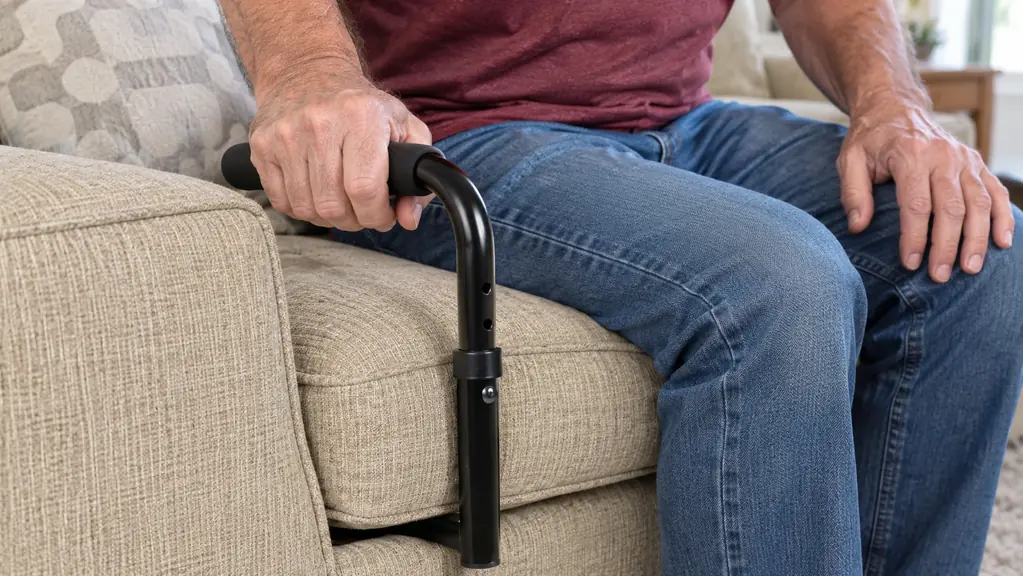
There is a real difference between pulling on a person and pushing on a frame. When Ray grabbed my arm, his weight came sideways and mine went with it. The Vive rail sits at hip height beside the cushion, so he plants his palm flat and pushes straight down. His hips come forward, his feet take the load, and he is up. Nobody's shoulder gets yanked. That one change in direction is most of the reason this works.
It fits the couch you already own, so nothing gets rearranged
I measure before I recommend anything. That is the mistake I saw most in client homes, someone buys a big piece of equipment and then the living room has to be rebuilt around it. This rail fits snugly around the base of a secure cushion or slides beneath a loose one, and the manufacturer says it works with any cushioned seating. Our living room is roughly 12 by 14 feet with carpet over a concrete slab, and the couch has a removable cushion. The rail tucked in and nothing else in the room moved.
The frame is rated to hold 300 pounds
It is aluminum, rated to 300 pounds. Ray is a big man and I have watched enough furniture fail under him to care about that number. What it means in practice is that you can put your whole weight onto it while you are in the half-seated position where your knees are bent and your balance is worst. If you have ever felt a side table start to tip under your hand, you understand why a stated weight limit matters more than how the thing looks.
At 2.7 pounds, it follows you from room to room
The whole rail weighs 2.7 pounds. I can pick it up with one hand and so can Ray. That sounds like a small thing until you realize the chair you struggle with is not always the same chair. Couch in the living room, hard chair at the kitchen table, the seat in the den where he watches the ballgame. One rail moves between all of them. It also means a visiting friend or a grandchild recovering from surgery can use it without anyone buying a second one.
It adjusts, so it works at more than one seat height
The rail is adjustable, which matters more than people expect. A dining chair and a deep recliner put your hips at completely different heights, and a fixed frame is only right for one of them. I am 5 foot 3 and Ray is 5 foot 11, and we both use this one, which we could not do otherwise. If your household has two people of very different sizes, or one chair that sits lower than the rest, adjustability is the feature that keeps it useful.

It fixes the first few inches, which is where the trouble actually lives
People assume the hard part of standing is the last bit, straightening all the way up. It is not. The hard part is the first few inches, when your hips are still below your knees and everything you have to push against is a cushion that sinks. That is the point where Ray used to stall and then sit back down. With a rigid rail under his hand, that moment stops being a decision. Once he is past it, his own legs finish the job.
It is useful during recovery, not only after it
I am not a therapist and I do not hand out medical advice. What I can tell you is what I saw in client homes after knee and hip work, when bending and twisting are limited and a soft couch becomes an obstacle course. A rail gives you a controlled way to push up without twisting toward an armrest. It is also the first thing I would put in the room for someone coming home from the hospital, before the walker has a place to live and long before anyone is shopping for a new chair.
It takes the load off the caregiver's back too
Twenty four years of in home care and my lower back has opinions. The worst part of that work was never the lifting. It was the half lift, where someone grabs your forearm and you take their weight at a bad angle. A rail moves that load off the caregiver and onto aluminum. My back notices the difference by the end of the day. It also means a daughter or a neighbor can help without being taught a transfer technique first, which is worth a great deal when the help is occasional.
Cleaning it takes about ten seconds
Aluminum, wiped with a damp cloth. That is the entire maintenance routine. No fabric, no seams collecting crumbs, no cushion to launder. In client homes things got spilled constantly and I was often the one cleaning up. Anything that can be wiped down between two users, an elderly parent in the morning and a visiting relative in the afternoon, is a piece of equipment people actually keep using instead of quietly setting in the garage.
The lifetime guarantee means one decision, not a replacement cycle
It comes with a lifetime guarantee from Vive. I have thrown out enough plastic grab bars and flimsy folding stools to be skeptical of anything in this category, so a guarantee that covers the frame for as long as you own it changes how I think about the purchase. You are not supposed to be shopping for this twice. You buy one, you keep it by the couch, and it is still there when the next knee acts up.
What I'd Skip
If you cannot get out of a chair at all, even with something to push against, skip this and look at a lift chair instead. That is a different machine and a different conversation, and I have written about the difference elsewhere. I would also skip buying two of these for one house. It moves, so buy one and carry it. And be honest about the seat you are fitting it to. The rail is only as steady as the cushion base it sits against, so a sagging couch with a torn foundation is not the place to start, no matter how good the rail is. Fix the cushion first or move the rail to a sounder chair. The last thing I would skip is buying it for someone who has not agreed to use it. A rail by the couch is only worth anything if the person sitting there reaches for it.
The rail did not make Ray stronger. It gave him a fixed point at the exact moment his hips were below his knees, and that was enough to get him off the couch without my arm under his.
One rail, one living room, and the couch stops being the hardest part of the day
Aluminum frame rated to 300 pounds. Fits around or beneath the cushion on seating you already own. Wipes clean with a damp cloth.
Amazon Check Today's Price on Amazon →