

Ray had his knee replaced two years ago and he still does this thing where he rocks forward three times before he stands up. The third rock is the one that worries me. The first two are warm-up. The third one is commitment, and if his foot slips or the cushion gives, he is going down. We borrowed a lift chair from a neighbor for the six weeks after his surgery, and when it went back to her, Ray went back to rocking. So we bought the MCombo 7040 in the medium size, and it has been sitting on the carpet in our living room ever since.
This is not a review written from a showroom. I am 68, I spent 24 years as a home health aide helping people get out of chairs and beds, and I have watched more transfers than I can count. Ray is 73, five foot eleven, broad through the shoulders, and he is the one who uses the lift every day. I am five foot three and I mostly use the recline. Between the two of us the chair runs constantly, which is the only kind of testing I trust.
The Quick Verdict
A steady, honest lift chair that does the one job you bought it for. It is heavy, it needs clearance behind it, and the lumbar heat is mild, but after months of daily use Ray stands up in one motion without rocking.
Amazon Check Today's Price →The chair that ended the three-rock stand
A counter-balanced lift with a TUV certified actuator, two lighted buttons on the remote, 8 vibration points and 1 heated lumbar pad. Ours has run every day for months without a stutter.
Amazon Check Today's Price on Amazon →How I've Used It
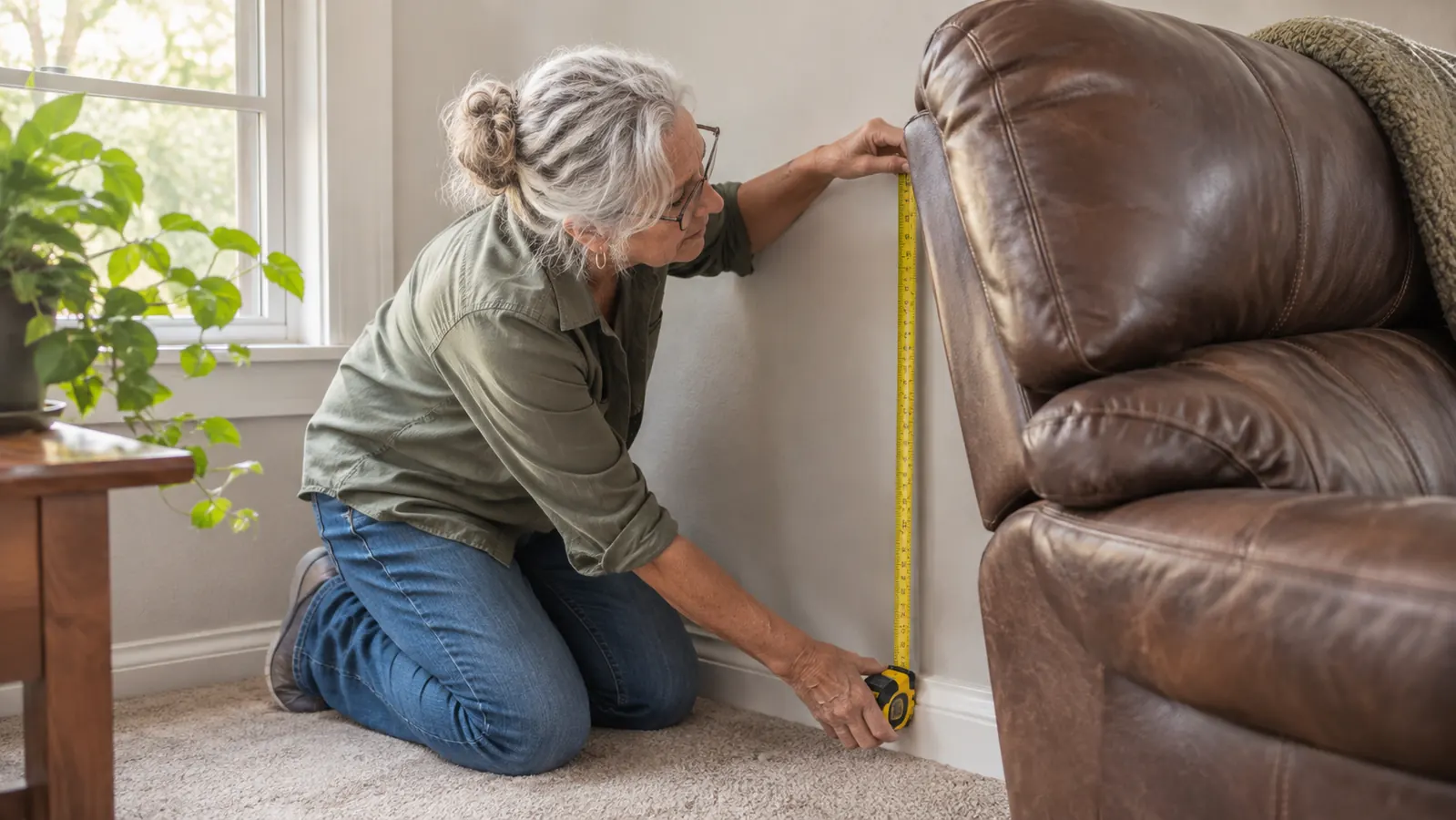
Our living room is about 12 by 14 feet, carpet over a concrete slab, and there is exactly one wall outlet behind where the recliners sit. That outlet decided the layout. The chair is 35.8 inches deep and 35.2 inches wide, so I measured the space to the fireplace hearth and then measured it a second time, because I have been burned before by a chair that fit right up until it reclined. It cleared. Barely, but it cleared.
The MCombo arrives in pieces: backrest, both armrests, the base, the accessories box and the manual. It weighs 105 pounds assembled, so you are not carrying that up a flight of stairs by yourself. We slid the base in on a moving blanket, set the armrests, dropped the backrest into the brackets, and ran the single cord to the outlet. The manual is thin, but the pictures are clear enough, and Ray had the armrests lined up before I had finished reading the page.
The delivery came on a Tuesday morning in two boxes, and the driver left them on the porch because he was not going to get them through the front door either. I signed for them on the back of a grocery receipt. We opened the boxes in the garage, carried the pieces in one at a time, and I kept the manual on the kitchen counter for two weeks like a recipe I did not trust yet.
The first week I did not trust it. I stood up the old way, out of habit, and the chair lifted underneath me while I was already half up, which felt strange. By the second week I had stopped fighting it and started letting it do the work. That adjustment period is worth mentioning, because I have watched people give up on a lift chair in three days and decide it is too slow or too fussy when they were simply still standing up out of habit.
What I actually do with it: I sit in the morning with coffee and put the back down two notches to take the pressure off my lower back, which stays stiff until about ten o'clock. Ray uses the lift every single time he gets up, which is more often than he will admit. Between the two of us the chair runs through a full up and down cycle maybe eight to twelve times a day.

What the Lift Mechanism Actually Does
The lift is the whole point, so let me be plain about it. MCombo's counter-balanced lift mechanism with a TUV certified actuator raises the entire chair, seat and all, and tips it forward until you are standing rather than climbing out of a hole. You are not pushing yourself up out of a low seat with your arms and one good knee. The chair does the rising, and you steady yourself and step off.
In practice, Ray gets up in one motion now. He still puts a hand on the armrest, which I like, but the rocking is gone. What surprised me is that he also uses the lift to get in. He backs up to the chair, sits on the raised edge, and lets it lower him down, which is a great deal easier on the knee than dropping into a seat. Aides call that a controlled descent, and it matters more than most people realize in the first months after surgery.
My first instinct was to push the chair into the corner by the bookshelf, which is where the old recliner lived. That lasted one afternoon. When I ran the back down to test it, the top of the chair stopped about four inches short of the shelf and I had to finish the recline with my hand on the button, sitting half up like a fool. We pulled it out, and it has lived eighteen inches off the wall ever since.
Two things to know. The chair needs room behind it for the back to lay down, so do not push it tight against the wall. And the lift motion is slow and steady on purpose. If you are expecting something that pops you to your feet, this is not that, and it should not be.
The Remote, the Vibration and the Lumbar Heat
The remote has two lighted buttons for the lift and recline, which is the correct number of buttons for a chair aimed at people who do not want a manual. They light up, which sounds like a small thing until you are trying to find them at nine at night with the lamp off. Ray keeps his on the armrest. I keep mine in the side pocket, because otherwise it ends up on the floor and neither of us should be bending down to fetch it.
There are 8 vibration points around the chair and 1 lumbar heating point, both running off the same controller. I want to be honest here: the heat is gentle. It is a warm pad against your lower back, not a heating blanket, and it takes a few minutes before you notice it at all. I use it on cold mornings and I run the vibration on low while I read. I would not pay for those features on their own. As a bonus on top of the lift, they earn their keep.
The backrest is adjustable independently of the footrest, which means you can sit upright with your legs out or lay back with your knees up. That took me about a week to stop fiddling with. Now I set it once in the morning and leave it alone until evening.
The other thing about the remote is reach. If the person using the chair cannot lean forward comfortably, that controller needs to live within arm's length at all times, which is why the side pocket matters more than the feature list suggests. Set the heat, set the vibration, sit back, and leave it.
Fit, Footprint and the Carpet Question
This is the part I would tell anyone to sort out before they order anything, not just this chair. Measure the width of the doorway the delivery has to come through. Our front door is 32 inches and the chair is 35.2 inches wide, so it came in through the garage on its side, in pieces, which worked fine. If you are in an apartment with a narrow hallway and a tight turn, work that out first, and do it with a tape measure rather than an eyeball.
We also checked the outlet. There is one behind the chair and it is the only one on that wall. The cord reaches without an extension, which I was not sure about when we ordered. If your only outlet is across the room, plan for an extension cord rated for the motor and tape it down along the baseboard so nobody catches a foot on it in the dark.
MCombo recommends carpet, and ours sits on carpet over a concrete slab. It does not slide when the lift runs. I would not put it on bare hardwood without something under the feet, because the lift tips the chair forward and I want it planted where I put it.
Seat height is the other thing. I am five foot three and my feet reach the floor comfortably when the chair is upright. Ray at five foot eleven fits the medium without feeling cramped through the shoulders, but he is near the top of the range for it. If you are noticeably taller than six feet, look at a bigger chair from whoever you buy from, because a lift chair you cannot get your legs under is not helping you.
How It Has Held Up Over Months
Months in, the lift is still smooth and still quiet. No grinding, no stutter, no moment where it hesitates halfway up. The upholstery on the armrests has softened where Ray's hands land, which is normal and not wear in any way that matters. The seat cushion has not flattened out, and that was my real worry, because a lift chair with a collapsed seat is just a heavy chair.
Six months in, on a Saturday afternoon, I noticed the lift was quieter than the day it arrived. It was not. It was just that I had stopped hearing it. That is the kind of thing you notice when a machine has become part of the house, and it is also the reason I did not write this in week two, when everything still felt new and I was being careful with it.
Ray's routine has not changed much since the chair arrived, which is the point. He gets up, the chair lifts, he steps off, he comes back, he sits, I hear the motor run for a few seconds, and he is settled. The only maintenance we have done is dusting the base and checking that nothing has worked its way under the frame. No service calls, no replaced parts, no phone calls to anybody.
The one thing I would change is the weight. At 105 pounds, this chair does not get moved. Not to vacuum under it, not to rearrange the room, not ever, unless Ray and I both put our backs into it and regret it. I vacuum around it with the wand attachment and I have made peace with the dust behind it.
I also want to say something about the size of the thing in a small room. Our living room is 12 by 14 and this chair plus the couch makes it feel fuller than it used to. It stands 44.5 inches tall at the back, so it does not disappear against a low wall. If your room is small and you are already short on space, measure twice and then measure once more.
What I Liked
- The lift does the work. Ray stands in one motion without rocking forward or pushing off the armrests.
- Two lighted buttons on the remote, which is the right amount of control for someone who does not want a manual.
- 8 vibration points and 1 heated lumbar pad. Gentle, but genuinely pleasant on cold mornings.
- The adjustable backrest works for sitting upright to read and for laying back in the evening.
- Held up over months of daily up and down cycles with no grinding and no hesitation.
Where It Falls Short
- 105 pounds. Once this chair is in place, it stays in place.
- Needs clearance behind it for the back to lay down, which rules out a tight corner.
- The lumbar heat is mild. Nobody should buy this chair for the heat alone.
- In a 12 by 14 living room it takes up real estate and looks exactly like what it is.
Ray gets up in one motion now. The rocking is gone, and that is the only review that matters to me.
Who This Is For
This chair is for someone who struggles to stand from a low seat and is not going to do the exercises to fix that, or who is recovering from a knee or hip replacement and needs help now rather than eventually. It is for a household where one person does the lifting and the other person does the sitting, and both of them are tired. It is also for the adult child shopping for a parent, probably reading this at eleven at night, trying to choose between three chairs that all look the same. I have been on both sides of that.
If you are the one shopping, the question I would ask is not which chair has the most features. It is who is going to measure the space, who is going to receive a 105 pound delivery, and who is going to sit with your parent the first afternoon and show them the buttons. Get those three answers straight and the chair choice gets a lot easier.
Who Should Skip It
Skip it if the person using it is much taller than six feet, because the medium will feel tight through the legs. Skip it if your living room has no wall space with clearance behind the chair, because the recline needs room to travel. Skip it if the chair will need to move regularly, since at 105 pounds it is furniture in the truest sense of the word. And skip it if you are mainly buying it for the heat and the vibration, because those are a nice extra on top of a lift chair, not a reason to buy one.
One more thing on that. If the person who will sit in this chair is stubborn about accepting help, expect it to sit unused for a month before they admit they like it. That is not a reason to skip it. It is a reason to expect a slow start and to not make a thing of it when it happens.
Measure the wall, then order the chair
35.8 inches deep, 35.2 inches wide, 44.5 inches tall, 105 pounds, and a TUV certified lift that has run daily in our living room for months. If it fits your space, it will do the job.
Amazon Check Today's Price on Amazon →