

A standard recliner is a fine chair until the day you cannot get out of it. I have watched that moment in other people's homes and I have watched it in mine. Ray is 73, a retired machinist with a knee replacement a couple of years behind him, and he still has trouble rising from low seating. The old recliner in our living room was a good chair for about ten years. Then it became the chair he had to rock forward three times before he could stand, and I would hear him from the kitchen and come in and hold out my arm. He hated that more than the pain. We tried the obvious things first. A firmer cushion on the seat. A wooden riser under the front legs. Moving the coffee table so he had room to plant his feet. None of it changed the real problem, which was that the seat was low and the chair was never going to help him up. The MCombo 7040 power lift recliner is the chair that solved that problem for us. A standard recliner is still the better choice for some people, and I will tell you exactly where it wins. But if standing up is the hard part, the 7040 is the one I would put in the living room first.
I am Loretta Ainsworth. I am 68, I spent 24 years as a home health aide, and I have helped more older adults out of chairs than I can count. Our house is a single story brick ranch outside Knoxville. The living room is about 12 by 14 feet, with carpet over a concrete slab and one wall outlet behind where the recliners sit. We tested the MCombo 7040 in that room, day after day, with Ray in it. This is not a lab report. It is what I noticed in a real house with one husband and one living room.
| MCombo 7040 | Standard Recliner | |
|---|---|---|
| Getting out of the seat | Powered lift raises the whole chair to help you stand, using a counter-balanced lift mechanism and TUV certified actuator | You push off with the arms or work a lever to bring the footrest down. No lift. |
| Back support | High back, adjustable backrest, and power recline | Recline varies by chair. Many have a fixed back and a lower seat. |
| Heat and vibration | 8 vibrating points around the chair and 1 lumbar heating point | Usually none. A few add manual massage. |
| Controls | Two lighted buttons on the remote for lift and recline | Lever or hand paddle. Simple and no power needed. |
| Footprint | 35.8 inches deep by 35.2 inches wide by 44.5 inches high | Varies. Measure before you buy either one. |
| Weight | 105 pounds | Often lighter and easier to slide or move |
| Power dependence | Needs the wall outlet to move the lift or recline | Works without power |
| Fabric and style choices | Medium size, listed as the 7040 model | Wide range of fabrics, sizes, and styles |
| Best for | Daily help standing, heat, and an adjustable back | Reading and napping with a simple manual recline |
Where MCombo 7040 Wins
The lift is the reason to buy it. The 7040 uses a counter-balanced lift mechanism and a TUV certified actuator to push the whole chair up. Ray presses one of the two lighted buttons and the seat rises under him until his feet are flat on the carpet and he can stand. Takes about six seconds. I timed it once out of curiosity. The first week we had it, he used the lift maybe eight or ten times a day, more than he needed to, because it was new and because he could. By the second week it settled into a routine: button, stand, walk to the kitchen, come back, sit down. Before the chair, that same trip took him three tries, a hand on the sofa arm, and a comment under his breath. I do not have to stand in front of him and pull anymore. That matters more than any fabric choice. In my aide work, the chairs that helped most were the ones that gave people a way to stand on their own schedule, without waiting for help. The MCombo 7040 does that.
The second win is the back and the heat. The chair has a high back, an adjustable backrest, and power recline. It also has 8 vibrating points around the chair and 1 lumbar heating point. I use the heat on my lower back in the morning when it is stiff, usually for fifteen or twenty minutes with my coffee. Ray uses the vibration after he has been sitting too long. This is not a medical device and I am not making a medical claim. It is comfort, and comfort is why he stays in the chair instead of perching on the edge of it, which is its own kind of fall risk. The medium size and the 35.2 inch width fit our 12 by 14 living room without blocking the walkway to the hall.

Where a Standard Recliner Wins
A standard recliner wins on power. The 7040 needs the outlet behind it to move the lift or the recline. If the power is out, the chair stays exactly where you left it. We lost power for a day and a half in an ice storm a few winters back, and that is the morning I think about when someone asks me this question. A manual recliner does not care. For a person who can get up on their own and just wants a comfortable chair for reading, a standard recliner is simpler and has less to go wrong. That is not a small point. I have seen plenty of people buy a power chair they did not need, and then the chair sits in the corner with a blanket folded on it because the person never touches the lift.
It also wins on weight and choice. The 7040 is 105 pounds. That is a two-person move if you want to rearrange the room, and it is not a chair you shove aside to vacuum. I vacuum around ours and I do not move it. A standard recliner is often lighter and easier to slide on carpet, and easier still on a hard floor. It also comes in more fabrics, sizes, and styles. If you want a chair to match a sofa you have had for twenty years, you have a much better chance of doing that with a standard recliner than with any lift chair. If your main goal is matching the room and having a place to put your feet up, the standard recliner does that job with fewer parts and no cord. I would not talk you out of one if that is your situation.
If standing up is the hard part, this is the chair to measure first
The MCombo 7040 is 35.2 inches wide, 35.8 inches deep, and 44.5 inches high. Check your doorway and your wall space before you order. Then check today's price on Amazon.
Amazon Check Today's Price on Amazon →How It Fits in a Small Living Room
Our living room is 12 by 14 feet. The chair is 35.2 inches wide, 35.8 inches deep, and 44.5 inches high. It sits on carpet over concrete, and the listing recommends carpet, which is what we have. The base is heavy enough that it does not slide when Ray pushes down on the arms to stand. The outlet is behind the chair, which is where the power cord needs to go. If your outlet is across the room, plan for that before delivery day and not after. Delivery itself is its own project. The chair arrives in pieces, and the box is heavy enough that the driver will want a clear path to the door. The listing includes the backrest, left armrest, right armrest, base, instruction manual, and an accessories box, so plan on some assembly. Ray and I put ours together in the living room in about an hour with two sets of hands. Do not try it alone at the bottom of a staircase.
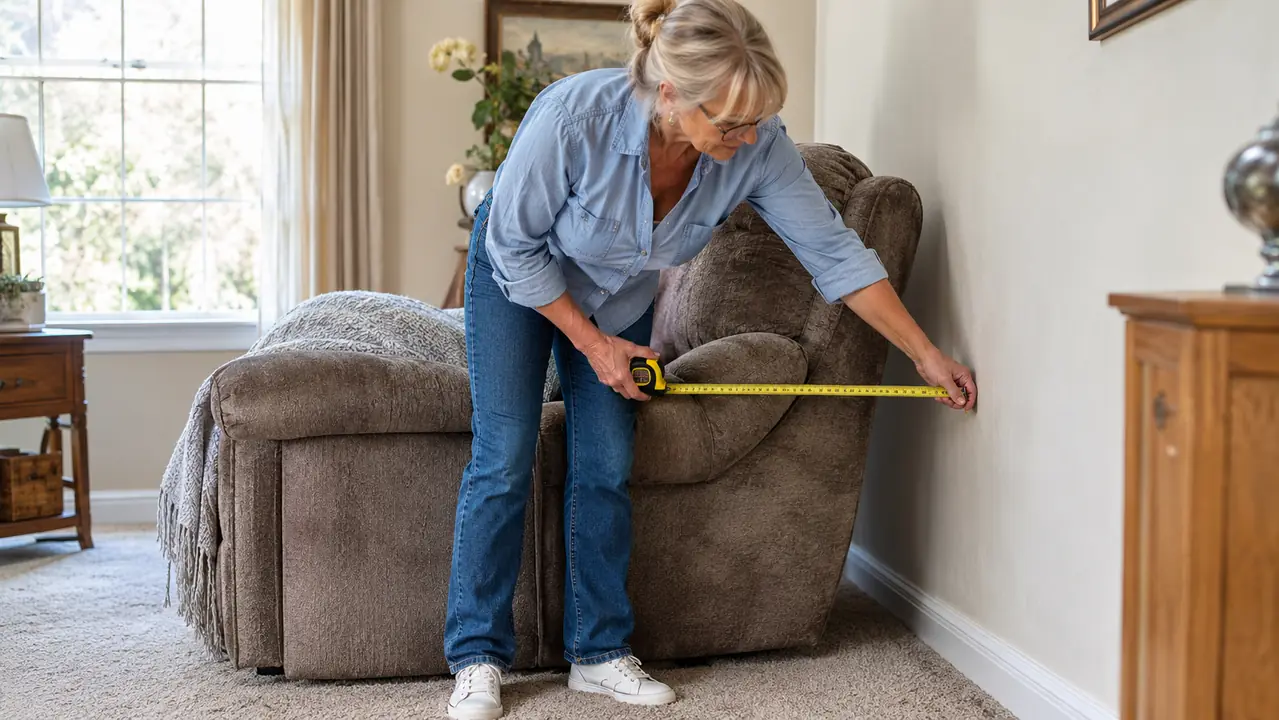
The back is high, so it takes up visual space. In a small room, that matters, and I measured the wall before we moved it in. I also measured the path from the front door. Our front door is 32 inches wide. The chair is 35.2 inches wide, so it does not walk through that door in one piece. It goes in as parts or on its side, and I would rather tell you that now than have you find out on a Saturday morning with a truck in the driveway. We also pushed the coffee table back about eight inches, because the footrest needs room in front of the chair when it comes up. The chair needs a few inches behind it too, so the back can go down without rubbing the wall. In a 12 by 14 room, eight inches is a real trade. It was worth it for us.
What the Remote Does and Does Not Do
The remote has two lighted buttons. One handles the lift, one handles the recline. That is it. This is not a chair with memory presets, an app, or a dozen modes, and I am glad of that. My hands are not as steady as they used to be, and a simple remote with lighted buttons is easier to use in a dim room than a panel of tiny labels. In the evening with only the lamp on, the lighted buttons are the reason Ray can find the right one without his glasses. The remote lives on the end table beside the chair. He has dropped it twice and it still works, but I would not make a habit of it. The lift and the recline are separate jobs and the remote keeps them separate, which means you cannot accidentally recline the chair while you are trying to stand up out of it.
The heat is one lumbar point. The vibration is 8 points around the chair. Neither is a substitute for a doctor or a physical therapist. If Ray's knee is swollen, the chair does not fix it. It gives him a comfortable place to sit and a safer way to stand, and that is the honest limit of what a recliner can do. The TUV certified actuator and the counter-balanced lift are the parts that matter for the standing job. The rest is comfort. I have heard salespeople call these chairs therapeutic. I would not go that far. What I will say is that a chair you can get out of is safer than a chair you cannot, and that is the whole argument.
The MCombo 7040 is not trying to be a smart chair. It is trying to get you standing.
What I'd Check Before You Buy
Check the seat height and the standing path. I am 5 foot 3 and I want my feet on the floor when I sit. Ray is 5 foot 11 with broad shoulders. The 7040 is a medium, and a medium is not a universal size. Before we bought, I sat in my old chair with a tape measure and wrote down the distance from the floor to the back of my knee. Twenty years ago I would have guessed at that number. Now I write it down and keep it. Then I compared it to the seat height of the chair I was considering. Do not guess. And if you can sit in one first, at a store or in a neighbor's house, do it. Ten minutes in the chair tells you more than a page of dimensions.
Check the outlet and the cord. The chair needs power, and ours needs it where the chair will actually sit, not where it is convenient to plug in a lamp. Our outlet is behind the recliners, which is handy until you need to reach it. If you have to unplug the chair often, that is a stretch and a bend every time. Plan the outlet before the chair arrives. Also think about the floor. The listing recommends carpet, and ours sits on carpet over concrete. On a hard floor the base may behave differently when someone pushes down on the arms. I have not tested ours on hard flooring, so I will not pretend I have.
Check the weight and the doorway. The 7040 is 105 pounds. It is not a chair you move by yourself, and it is not a chair you slide out of the way when the grandchildren visit. Our front door is 32 inches wide and the chair is 35.2 inches wide, so measure the door, the hallway, and the turn into the room before you order. If there is a step or a threshold, measure that too. It is the least glamorous part of buying a chair and the part most people skip. I skipped it with a sofa once and paid for it with a hole in the drywall.
Who Should Buy Which
Buy the MCombo 7040 if you or the person you care for has trouble standing from a low seat, if a knee or hip replacement has changed how you get up, or if you want heat and vibration in the same chair. It is also the better pick if you have carpet and a wall outlet where the chair will sit. Buy a standard recliner if you can stand up without help, if you want a chair that works when the power does not, or if you mainly want a simple place to read and nap. If you are shopping for a parent, watch them get out of their current chair before you buy anything. Count how many tries it takes. That tells you more than any list, including mine.
The right chair is the one that gets you standing without help
The MCombo 7040 is a medium power lift recliner with a high back, adjustable backrest, 8 vibrating points, and 1 lumbar heating point. Check the dimensions, check your outlet, then check today's price on Amazon.
Amazon Check Today's Price on Amazon →