

I bought the Vive Stand Assist in March for Ray's side of the couch, four months after his knee replacement, because I could not stand to watch him rock forward and back three times before he got up. He is 73, five foot eleven, still broad through the shoulders from a lifetime of machinist work, and the couch in our living room sits low on carpet over a concrete slab. I figured a frame with a handle on it was worth a try. This is the version I would give a neighbor, including the parts the listing leaves out.
The short answer is that it works, and it works better than the closet rod I had wedged under the cushion before it. The Vive Stand Assist is an aluminum frame, 2.7 pounds, rated to support up to 300 pounds, that tucks under a cushion or sits around the base of one. It gives you a handle at hip height and something solid to push against. What it does not do is lift you. That one difference is most of this review, so let me get to it.
The Quick Verdict
A sturdy, light, well placed handle that gets a person with working arms up off a low couch. It is not a lift, and the people who need a lift should put the money on a lift chair instead.
Amazon Check Today's Price →2.7 pounds, no wiring, and Ray stands up on the first try
It sits under the cushion at the front of the seat and puts a handle where your hand already wants to go. Nothing to charge and nothing to plug in, and it moves with you from the couch to the kitchen chair. Measure your cushion depth before you order and give yourself twenty minutes to fit it properly.
Amazon Check Today's Price on Amazon →How I've Used It
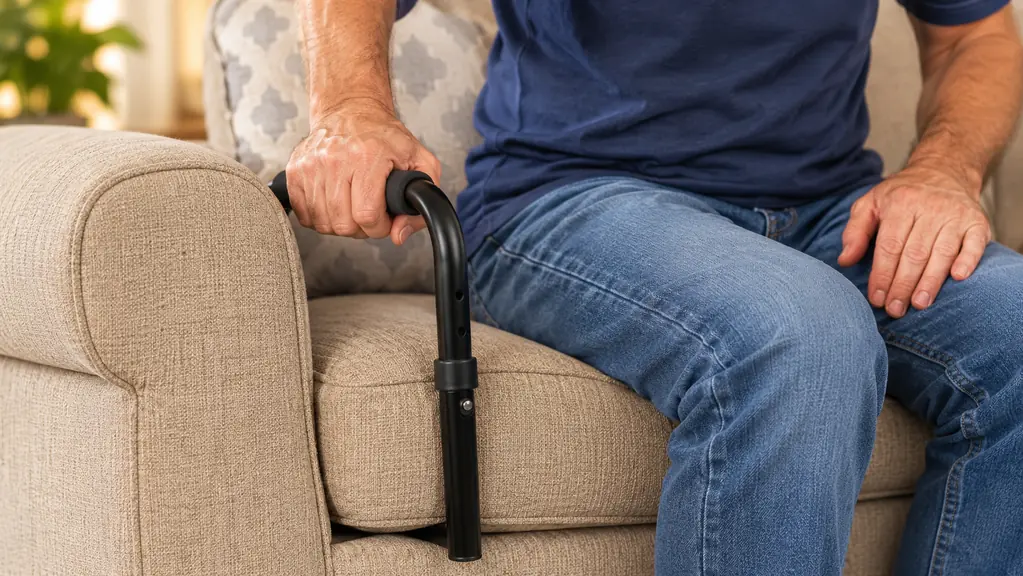
I put it on Ray's side of the couch, the low one, and I have used it myself on the mornings my lower back is stiff, which at 68 and five foot three is most mornings in February. The first fitting took about twenty minutes, mostly spent figuring out where the frame wanted to live. On our couch the seat cushion is not removable, so the frame went between the cushion and the arm, with the handle standing up near hip height when Ray is sitting. It measures 22.25 inches wide and 12 inches tall, and it is adjustable, which is the number that decides whether it fits your furniture at all.
The first week was a trial. The frame slid forward twice when Ray pushed off, and the second time he went sideways enough that I put my hand out. What fixed it was moving the frame back an inch and making sure the cushion sat down over the frame instead of resting on top of it. It has not moved since. I check it every Sunday the way I used to check equipment in my clients' homes, and I wipe the handle with a damp cloth when it looks grubby, which is what the care instructions call for and takes about four seconds.
What I noticed inside the first month is that Ray stopped hesitating. That is not a small thing. Before the rail he would perch on the edge of the couch working up to standing, and I would find something to do in the kitchen so I was not watching him. Now he plants his feet, takes the handle, and he is up. He still takes my arm sometimes and I still do not love it, but it is once a day instead of every single time.
I have also carried it into the kitchen for the straight chair at the table, and out to the car when we drive to his sister's place in Maryville. It weighs 2.7 pounds, so it lifts out with one hand and goes back in just as easily. That portability is the reason I would buy it again before I would buy anything bigger.
Ray's physical therapist looked at it in April and said the handle height was right for him, which I took as a small vote of confidence. She also said what I have been saying here: the work is in the arms and the timing, and the rail does not do the work for you.
The Part Nobody Tells You: It Is Not a Lift
This is what I would say first if a neighbor asked me in the driveway. The Vive Stand Assist is a handle. It is a well placed, sturdy, wide handle, and pushing against it is the entire mechanism. It does not raise you. Your arms raise you.
That matters, because the people who most need help out of a chair are often the people with the least arm strength left. In twenty four years of home health work I had clients who could not have used this at any body weight, because their shoulders were gone or their grip was gone, and no handle on the market fixes that. If you or your parent cannot push down through an arm and hold it for three seconds, this frame will end up behind the couch and a lift chair is the honest answer.
Ray can push. Forty years of machinist work left him with good upper body strength, and his problem was the knee and the height of the seat, not his arms. That is the person this rail was built for. When somebody tells me it did not help their mother, I usually find out the mother needed lifting and not a handle, and that is a different purchase with a different set of tradeoffs.
It is a handle, not a hoist. If your arms cannot push, no rail on the market will stand you up, and the money belongs on a lift chair instead.
Fitting It Right Takes an Afternoon and Some Patience
Measure before you order, and measure with the cushion in place. You want the width of the seat and the gap between the cushion edge and the arm. A couch that swallows the frame is a couch where the frame will not stay put, and that is the most common reason I have seen these things fail in somebody's house. Ours is a plain three seat couch and it took one adjustment to settle.
The cushion matters as much as the frame. It wants some substance. A tired cushion that has lost its shape will let the frame walk forward, and a cushion so firm that it will not sit down over the frame will leave the handle standing proud and loose. Ours was middle of the road and it has been fine. If your cushion is a pancake, fix the cushion or expect trouble.
Give yourself twenty minutes and do it when nobody is tired. The instructions are short and the frame only goes together one way, but getting the fit right is a two hand job and a bit of kneeling on the floor. I did it in the afternoon with the light coming in the front window, and I was glad I had not left it for the evening.
What the 300 Pound Rating Actually Means
The frame is rated to support up to 300 pounds, and I believe the rating, because the aluminum is thicker than I expected for something that weighs 2.7 pounds. But read that number the way it is meant. It is how much the frame will hold, not how much weight it will help move. A 280 pound man who cannot push himself up is still a man who cannot push himself up, and the rating does not change that.
What the rating does tell you is that this is not a flimsy piece of equipment. I have leaned my full weight on it from an awkward angle, and Ray has grabbed at it in a hurry more than once, and the frame has not flexed or creaked. In a household where more than one person will use it, that is worth something.
The Small Things That Annoyed Me
The padding on the handle is thin. Ray does not notice and would not care if I pointed it out. On the mornings my hands are sore from arthritis at the base of my thumb, I notice, and I have folded a dish towel over it twice. A thicker grip would make this a better product for the person using it most.
It is not furniture. It is a metal frame standing up beside your cushion, and if your living room is the room you actually sit in and you care how the room looks, you will see it every day. I stopped noticing after two weeks. A visitor notices the moment they walk in.
And it does not fix the seat height. Our couch still sits low. The rail makes a low seat manageable; it does not make the seat taller. If what you want is for the seat itself to come up to meet you, that is an entirely different piece of equipment, and it costs more and takes up more room.

Six Months In
Six months on, the Vive frame looks like it did the day it came out of the box. No rust on the aluminum, no wobble at the joints, no fraying where the handle meets the frame. Wiping it with a damp cloth once a week has been the whole of the maintenance. I have had shower chairs and exercise equipment that did not hold up half as well, and I am careful about saying that.
Ray uses it every day and has stopped mentioning it, which in our house is the highest compliment a piece of equipment gets. I use it two or three mornings a week. Nobody has fallen. I want to be careful there, because a rail does not prevent a fall, and a person who is unsteady on their feet is unsteady whether or not they have a handle. But the moments when Ray was most likely to tip forward are the moments this frame is under his hand.
One thing I did not expect: it changed how Ray sits, not just how he stands. He used to perch forward on the edge of the cushion, half ready to get up. Now he sits back, because getting out is no longer a project. He is comfortable for longer stretches, and that was not the reason I bought it.
The lifetime guarantee is the piece I have not tested. I hope not to. In my working years I watched enough equipment fail in clients' homes to care whether a company stands behind a frame, and a guarantee that lasts the life of the product suggests they expect it to last. If it ever fails I will come back and say so.
What I Liked
- Gives a wide, solid handle at hip height for pushing up out of a low couch or chair
- 2.7 pounds and lifts out in one hand, so it moves to the kitchen chair and to the car
- Aluminum frame rated to 300 pounds, and it has not shifted since the first week
- Adjustable width sits around a standard cushion, and fitting is a one time job
- Wipes clean with a damp cloth and has shown no wear in six months
Where It Falls Short
- Does nothing for someone who cannot push with their arms
- Handle padding is thin for sore hands
- Needs a cushion with some body to it, or the frame walks forward
- Visible in the room and not something you could call furniture
- Does not change the seat height, so a very low couch stays a very low couch
The Other Thing People Ask Me
The question I get most is whether this replaces a lift chair. It does not, and the two are not close in what they do. A lift chair raises the seat and tips you forward so your legs are under you before you stand. This frame gives you something to hold while your own legs do the work. If you have the room and the budget, the chair does more. If you have a good couch you like and arms that work, the frame is far less fuss and you keep your living room.
I have used both. In my working years most of my clients had one or the other, and the ones who did best were matched to what their body could actually do rather than to what the family hoped. That is the whole of my advice on the subject.
Who This Is For
It is for someone who can stand but has to work up to it. Someone whose knee or hip is healing, someone whose couch is lower than their legs like the idea of, someone with enough arm strength to push down on a handle for three seconds. It is also for the caregiver who has become the handle, which is exactly where I was in February. Ray uses it every day. I use it on my bad mornings. Neither of us has needed anything more than that.
It is also a sensible first step for a household that is not ready to give up a corner of the living room to a lift chair. Try this first. If it is not enough, you will know inside a month, and you will know exactly what you need instead.
Who Should Skip It
Skip it if the person cannot push with their arms, if their grip is unreliable, or if they have been told to keep weight off one side. Skip it if the chair is a deep soft recliner where the cushion will not hold a frame in place. Skip it if the seat is so low that getting up is the entire problem, because the rail does not raise the seat. And skip it if nobody in the house will spend twenty minutes fitting it properly, because a rail that slides is worse than no rail at all.
The Vive handle Ray reaches for every morning, six months and counting
One aluminum frame, 2.7 pounds, rated to 300 pounds, no wiring and nothing to charge. Measure your cushion, fit it once, and check on Sunday that it has not shifted, the way I do.
Amazon Check Today's Price on Amazon →