
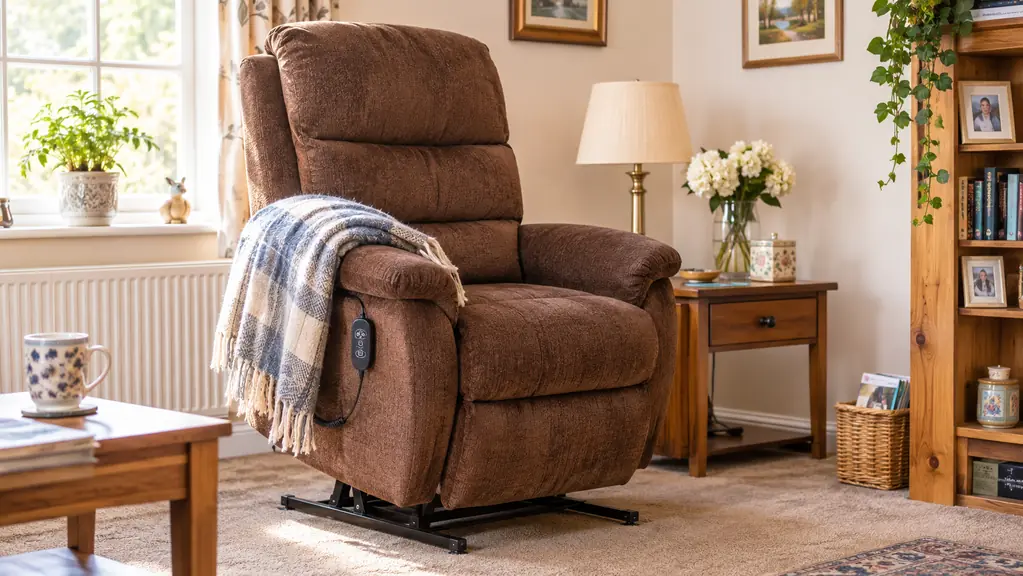
Ray had his knee replaced two years ago, and the recliner in our living room stopped being furniture and started being equipment. He is 5 foot 11 and broad through the shoulders, and the lift function is the only reason he gets out of that chair without rocking himself forward three times first. What nobody tells you about a power lift recliner is how much of your life ends up on it. Toast crumbs, coffee rings, the shine that builds on the arm rests where he pushes himself up. The chair also has a motor housing down near the floor that our vacuum hates, and a wide flat back that collects dust like a shelf. After two winters of scrubbing that chair by hand with a rag and a spray bottle, I wanted something I could pull off and throw in the machine.
I have been through a few covers on that chair. The first was thin enough that it slid off the back every time the lift ran. The second was stiff enough that the seat felt like a bench and the mechanism groaned against it. I have had the H.VERSAILTEX stretch lift recliner cover on the chair for months now, through a hot Tennessee summer and into the fall, and it has stayed where I put it. That is most of what I ask from anything in this house.
The Quick Verdict
A one-piece stretch cover that actually stays anchored through the lift cycle, washes clean, and keeps the remote within reach. It is not waterproof, and it will not rescue a collapsed cushion.
Amazon Check Today's Price →The Cover That Stays Put Every Time the Chair Lifts
One piece, machine washable, made for standard power lift recliners. Measure the sitting width and the back circumference before you order.
Amazon Check Today's Price on Amazon →How I've Used It
Ray runs that chair through four or five full lift cycles before lunch on a normal day. Footrest up, chair tipping him forward, chair settling back down. A cover that is not anchored will creep up the back inside a week, and I have re-tucked enough of them to know. This one has two elastic loops at the back corners of the seat that you pull down and hook, and that one detail is the reason it has stayed put.
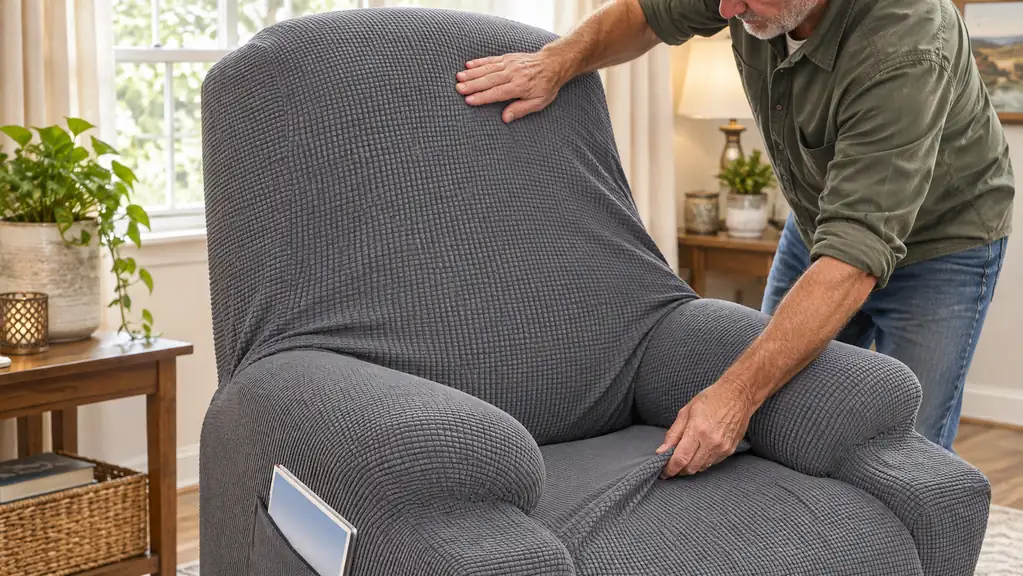
The first install took me about ten minutes. The second, after a wash, took three. You drape it over the back, work the fabric down over the arms, then push the seat section into the gap between the seat and the back rest. The H.VERSAILTEX listing has guide photos and I used them, because I would rather follow a picture than guess. My hands are not as strong as they were, and I did not need Ray's help or a second person.
The fabric is 85 percent polyester and 15 percent spandex, and the whole cover weighs about two pounds. That matters more than it sounds. A heavy slipcover fights a lift mechanism. This one moves with the chair, so when the frame tips forward the back panel goes with it instead of pulling loose at the top corners. The jacquard weave has some texture to it, which keeps it from looking like a bedsheet thrown over the chair.
The Fit Numbers Are the Whole Ballgame
Two numbers on the listing decide whether this works in your house: a back circumference of 78 to 88 inches, and a sitting width of 24 to 33 inches. Measure your own chair before you order anything, and measure the chair, not the old cover. Run a soft tape around the outside of the back at the widest point. Then measure straight across the seat cushions, between the arms, where a person actually sits.
Our chair came in at 31 inches across the seat and 84 inches around the back, which put it comfortably inside the range. Even so, I had to work the fabric over the arms, and I have decent reach. A chair at 33 inches is going to be tight. A petite lift recliner down around 23 or 24 inches of sitting width will leave you with fabric to spare that you will be tucking and re-tucking.
Measure with the chair upright, then again with it reclined, because the back circumference shifts a little as the frame moves. If your chair is already near the top of the range when it is sitting up, expect a snug fit when it lays back. Snug is not a problem. Too small is a problem, and it is not one you can fix by pulling harder.
If you have an oversized or bariatric lift chair, this is not the cover for you, and I would rather say so plainly than have you find out on install day. The listing stops at 88 inches around the back. There is no stretch in the world that gets a cover past a number it was not cut for.
Living With It Day to Day
The seat stays put, and I know how low a bar that sounds. It is the bar most of these covers fail. When Ray runs the lift, the back panel follows the frame rather than pulling away at the top. When he slides forward to stand, the seat fabric comes with him an inch or so and settles back down when he sits again. Nobody has to fix it between uses, which is the point.
The side pocket holds his lift remote and the television remote, which got them both off the end table and out from under a magazine. It is a small thing, and it is the thing he brings up whenever a neighbor asks about the cover.
The arms are covered, and on a chair like this the arms take the worst of it, because that is where he plants his hands to push up. After months, the fabric over the arms has held with no thin spot and no shine coming through. It is soft, closer to a knit than to a canvas, and it does not feel cold the way the vinyl underneath does on a January morning.
The footrest is the one place it needs a hand from time to time. When the footrest goes up, the fabric over the front edge pulls, and when it comes back down I smooth it with my palm. I do not think that is a defect. It is what a one-piece cover on a moving chair does, and it takes two seconds.
One honest note on looks. It reads as a soft textured cover, not as reupholstery. From across the room it looks tidy. Up close you can see where the fabric gathers at the outside corners of the arms, and I straighten those maybe once a week.
Washing It and What Held Up Over Months
Machine wash, cold, low dry. It has come through every cycle without shrinking enough for anyone to notice, and it goes back on easier than it did the first time, because the fabric has relaxed into the shape of the chair and stopped arguing with the corners. I wash it about every three weeks, more often if we have had company.
What I have seen after months of daily use: no pilling at the arms, no fading, and a small amount of stretch at the front edge of the seat where Ray's legs rub when he stands. The elastic loops are the part I keep an eye on, because elastic is always the first thing to give out on any cover. So far they are still doing their job, and I check them every wash.
Do not wash it with anything that has zippers or hooks. The stretch fabric will catch, and once it snags, that is where a run starts. I wash it alone or with towels and dry it on low rather than hot. It has held its size, which is more than I can say for the last one I bought.

Where It Falls Short
This is a stretch cover, not a waterproof barrier. A full cup of coffee spilled in the middle of the seat will soak through to the cushion if you are slow to get to it. If the reason you are shopping is a parent with incontinence, or a chair that takes a leaky cup several times a week, put a waterproof layer under this or buy a cover built for that job. I have written about the stretch against waterproof question elsewhere on this site, and it is worth five minutes of your afternoon.
It will not fix a chair. If the cushion has collapsed or the springs are flat, the cover will show every lump and hollow underneath. What it does is hide stains, wear and the general dinginess a chair gets after a few years of daily use. It does not rebuild the seat.
On a slick vinyl or leather lift chair it will slide a little when someone drops back into the seat. The elastic loops help. They do not turn it into fitted upholstery, and I do not want you expecting that.
What I Liked
- Two elastic loops at the back corners of the seat keep it anchored through the lift cycle
- Machine washable, and it has survived cold wash and low dry without shrinking
- Soft stretch fabric moves with the chair instead of fighting the mechanism
- Side pocket keeps the lift remote within reach instead of on the floor
- Covers the arms, which is where a lift recliner wears out first
Where It Falls Short
- Stretch fabric, not waterproof, so a spill soaks through if you are slow
- Fit tops out at 88 inches around the back and 33 inches of sitting width
- Slides some on slick vinyl or leather
- Fabric gathers at the outside arm corners and needs a hand now and then
- Will not disguise a collapsed cushion or worn springs
Two elastic loops at the back corners of the seat are the difference between a cover that survives a lift cycle and one you re-tuck twice a day.
What I'd Tell a Friend Standing in My Doorway
If a neighbor asked me about this cover with her coat still on, I would say measure first and buy second. Get the sitting width and the back circumference, write them on the back of a receipt, and hold those numbers up against the 24 to 33 and 78 to 88 ranges. That is the whole decision. Everything else, the fabric and the pocket and the washing, is secondary to whether it fits the chair you already own.
I would also tell her to buy it for the right reason. This is a cover for a chair that is used hard and looks it. It is not a repair, and it is not a waterproof pad. Buy it to make the chair easy to clean and pleasant to sit in again, and it does that job well.
Who This Is For
This is for the household where a power lift recliner gets used every single day and the upholstery is starting to show it. If you are covering a chair for a parent, measure the seat width and the back circumference first, write the numbers down, and compare them to the 24 to 33 inch and 78 to 88 inch ranges before you order anything.
It is also for anyone who would rather wash the chair than scrub it. Being able to pull the cover off, run it through the machine and put it back on in a few minutes has changed how that corner of our living room smells, and I am not exaggerating.
Caregivers, this is the part I would underline. If you are buying for a parent you do not live with, get them to measure, or measure it yourself on your next visit. Guessing from a photograph of the chair is how people end up returning covers and losing a weekend.
Who Should Skip It
Skip it if the chair is oversized or falls outside those measurements. Skip it if the problem you are solving is liquid, because a stretch cover is the wrong tool for that job. And skip it if the cushion has already given out, because a cover over a dead seat still feels like a dead seat.
The listing carries 4.2 stars across 868 ratings, and that is a fair picture. Most people are happy with the fit and the feel. The complaints I read before buying were mostly about size, and after months with it, I think size is exactly where the trouble would come from.
And skip it if you want a cover that looks like the factory upholstery. This is a soft stretch cover with a woven texture, and it will always look like a cover. That is fine by me. It is not fine for everybody.
Measure Your Chair, Then Give It a Cover You Can Wash
The H.VERSAILTEX one-piece stretch lift recliner cover fits standard power lift recliners with a back circumference of 78 to 88 inches and a sitting width of 24 to 33 inches. Machine washable, about two pounds, roughly ten minutes to install.
Amazon Check Today's Price on Amazon →