
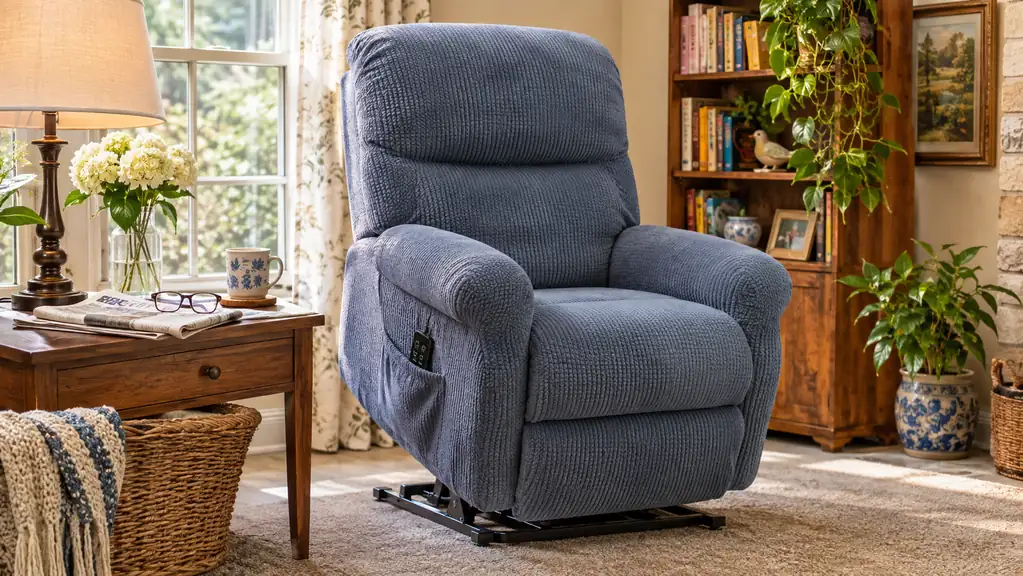
The first thing I noticed when I pulled the H.VERSAILTEX lift chair cover out of the package was how small it folded down. Two pounds of fabric, pressed into a rectangle about 14 inches by 13 inches, roughly the size of a hardback book. The second thing I noticed was the texture up close. It is a woven jacquard with a tiny check pattern, not a printed design, so the pattern lives in the cloth instead of sitting on top of it. I have covered a lot of furniture in my life, first in other people's houses during 24 years as a home health aide and now in my own living room outside Knoxville, and I can usually tell inside five minutes whether a slipcover is going to fight me.
This one fought me for the better part of an hour. Then it settled down, and it has been fine ever since. That is the honest summary of this review. The H.VERSAILTEX cover is a good product with one genuinely annoying first installation, two fit limits you need to measure for before you order, and a small design weakness I would change if anybody asked me. Nobody asked, so I am writing it down here instead.
The Quick Verdict
A soft, stretchy cover that makes an older lift recliner look intentional again, once you get it on. Measure the back circumference and the seat width before you order, and budget a second pair of hands for the first fitting.
Amazon Check Today's Price →It Fits Backs From 78 to 88 Inches Around and Seats 24 to 33 Inches Wide
Those two numbers decide everything. Measure them with a soft tape before you buy and the rest of this is easy. Order outside the range and no amount of stretch will save it.
Amazon Check Today's Price on Amazon →Let me back up, because a slipcover is an odd thing to write this much about unless you have lived with the problem it solves. In our house the problem had shiny arms, a flattened seat, and a husband who had started apologizing for his own furniture.
Why Ray's Chair Needed a Cover at All
My husband Ray is 73 and retired from machining. He had a knee replacement a couple of years ago and he still has trouble getting up out of anything low, which is why there is a power lift recliner in our living room in the first place. The chair itself works. The motor lifts, the footrest comes up, the whole thing does exactly what it promised. What wore out was the outside: the arms where his hands land every single time he stands, the front edge where his legs swing over, and the seat cushion where a grown man sits for two hours watching a ballgame.
The upholstery on the arms had gone shiny where the fabric had been rubbed smooth. That shine is what tells you a chair is old. Not the style, not the frame, not the mechanism. And once a chair looks like that, the person sitting in it notices it every day. Ray mentioned it twice in one week, which for him counts as a speech. The front edge had gone the same way by then, a pale strip about four inches deep where his legs swing over, and that strip was the part I noticed from the kitchen doorway.
I tried the cheap fixes first, the way most people do. A folded throw over the seat, which slid off every time the lift motor ran and ended up wadded on the floor. Then a set of quilted arm pads I ordered for about the cost of a good lunch, which covered the arms but left the shiny front edge bare and made the chair look like it was wearing elbow patches. Neither lasted a month. That is when I started reading listings properly instead of guessing.
A new lift recliner is a serious purchase and there was nothing mechanically wrong with this one. So a stretch cover was the sensible answer. Spend an afternoon, protect the arms from further wear, and make the chair look like it belongs in the room again. That is what this H.VERSAILTEX cover does. It is not a reupholstery job and it never pretends to be. It is a jacket.
What the Listing Does Not Tell You
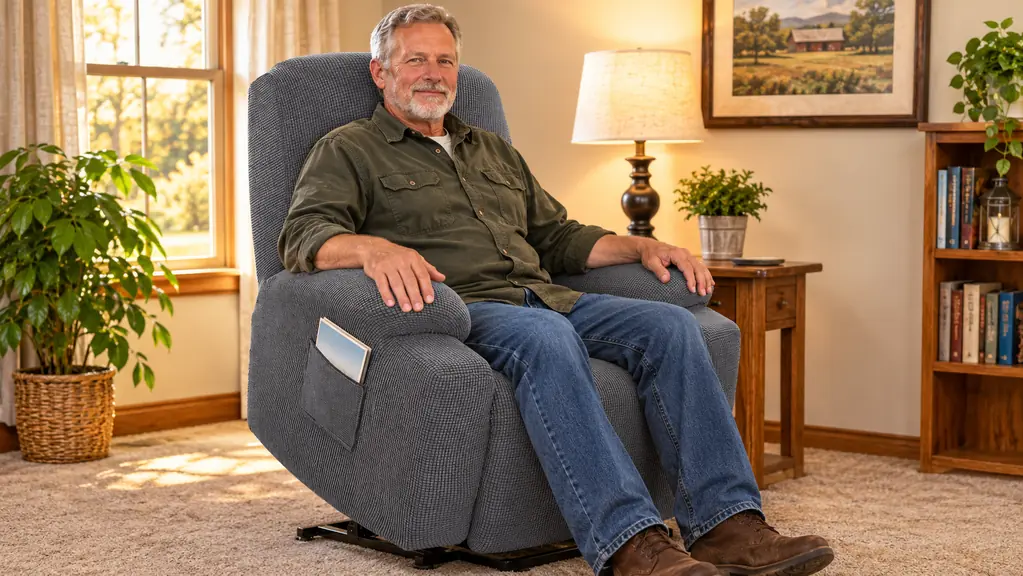
The listing leads with the fit range, and that range is the most important thing on the page. This cover is built for a back circumference of 78 to 88 inches and a sitting width of 24 to 33 inches. Our recliner measures 84 inches around the back and 28 inches across the seat, which puts it comfortably in the middle. Chairs at either edge of that range will still take the cover, but they will either strain at the seams or pool in the corners. Measure around the widest part of the back with a soft tape, measure straight across the seat from outside arm to outside arm, and write both numbers down before you order anything.
My own first measurement was wrong, and wrong in a way that would have cost me. I laid a metal tape across the seat cushion and got 21 inches, which reads as far too narrow and had me looking at a completely different product for two days. The number the listing wants is outside arm to outside arm, which in our case is 28 inches. I only sorted that out because Darlene next door has a lift recliner three years older than ours, and she straightened me out on the phone in about thirty seconds flat.
The second thing the listing buries is the material. It is 85 percent polyester and 15 percent spandex, machine washable, with an elastic closure. The spandex is why it grips at all, and why it stretches over thick recliner arms instead of fighting them. Two pounds of fabric is light. That is not a complaint, it is a fact worth knowing, because light fabric moves when a heavy body pushes against it.
The third thing I would put in bold if I ran that listing is that there are two elastic loops at the back corners of the seat section, and those loops are the entire anchoring system. You pull them through the gap behind the seat and hook them, and that is what keeps the front edge from creeping forward every time somebody stands up. If you skip the loops because you are tired and you want to be done, the cover will slide. I know, because I skipped them.
Getting It On: The Part Nobody Warns You About
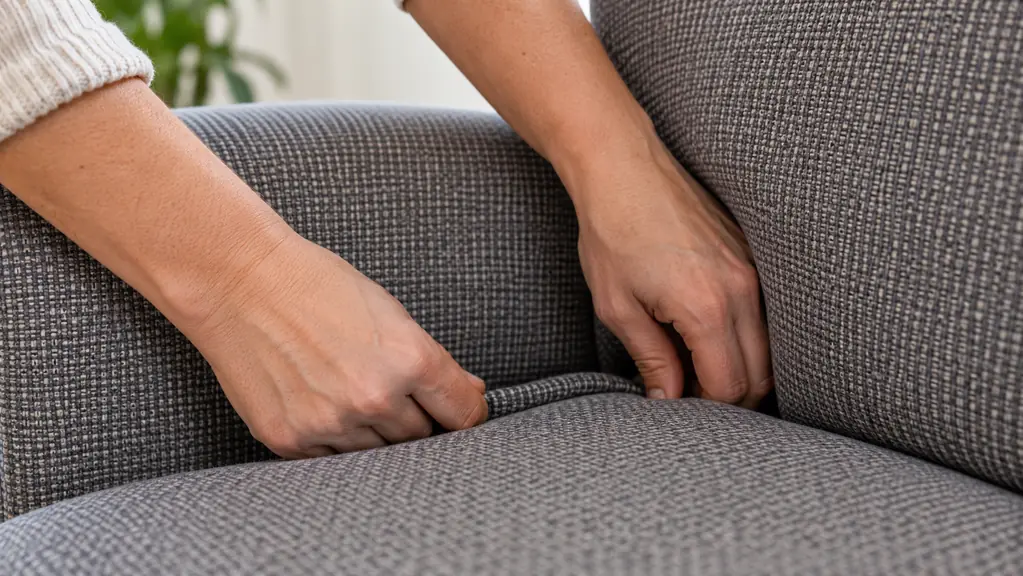
Installation is where this product loses the fifth star. The cover goes on roughly like a fitted sheet with ambitions. You start at the top of the back, work the fabric down over the arms, tuck the seat, then lift the footrest to reach the front and the sides. On a power lift recliner you have one real advantage over people with an ordinary recliner, because you can raise the chair with the remote and bring the front edge up to a height where you can reach it without kneeling on the carpet at 68 years old.
That is the good news. The bad news is the arms. A lift recliner has thick padded arms and the cover has to swallow them both, and the fabric will go, but not on the first attempt. I got one arm on, stood back, and found the whole thing had rotated about three inches to the left. Then I did it again. My advice is to accept that the first fitting is a two person job of about forty minutes, because pulling the back over the top of the chair while holding the seat in place takes more hands than you have.
I tried it alone first, on a Thursday afternoon, because Ray was at the hardware store and I am not patient. I got the back over the top of the chair and the entire cover slid straight down the front like a loose bedsheet. That is when I stopped and waited for him. Two people working together, one holding the back in place at the top and one feeding the arms down, and it went on in a single pass.
The second fitting took eight minutes. That is the number that actually matters. Every time since then, pulling it off to wash and putting it back on has been fifteen minutes at most. The packaging creases fell out within a day or two of normal sitting, without any ironing, which surprised me because they looked permanent coming out of the bag.
Living With It for Two Months
Ray uses that chair every evening. I sit in it in the mornings when my lower back is stiff and I want my feet on the floor instead of swinging. In two months of daily use the cover has held up better than I expected for two pounds of stretch fabric. The arms, which take the worst of it, show no shine and no thinning. The jacquard has not pilled and the seat has not bagged out. It goes in the washing machine and comes out looking the same, which is the whole reason I wanted a removable cover instead of a new chair.
The lift mechanism does its work underneath without complaint. When the chair rises, the fabric over the seat stretches and follows instead of bunching behind your back. When it comes back down you do have to smooth the seat with your hand, especially if you stood up quickly. That is a five second habit, not a problem. The side pocket, which I did not expect to use, has become the permanent home for the lift remote. That remote used to live on the end table and get knocked onto the floor about once a week.
The two elastic loops at the back corners are the entire anchoring system. Use them and the seat stays put. Skip them and the cover walks forward every time you stand up.
I want to be fair about wear, because this is what people ask me. A stretch cover is not upholstery. It does not carry the lifespan of a reupholstered chair and it is not built to. What it does is protect the two places a recliner always fails first, the arms and the front edge, and after two months both of those look new. If you are expecting factory seat cover toughness, you will be disappointed. If you are expecting another three or four years of the chair looking decent in your living room, that is exactly what you get.
There was one spill, a cup of coffee over the left arm in the second week. I pulled the cover off that evening, ran it through the machine on cold, and had it back on the chair before bed. The arm looked the same afterward. No ring, no fade, no change in the texture of the weave. That one evening is worth more to me than every line of marketing on the listing, because a chair you can wash is a chair that stops being a worry.
The Fit Numbers, and Why You Should Measure Twice
I measured three chairs before I ordered, ours plus two neighbors', and the pattern held. Chairs in the middle of the stated range fit with fabric to spare. Chairs near the top, around 87 or 88 inches around the back, went on but the fabric was working hard at those back corners. Chairs under 80 inches had slack at the sides that needed tucking. None of them failed. All of them needed the owner to know which situation they were in before the cover arrived, because a cover that fights the chair on day one is a cover that ends up folded in a closet.
The sitting width is the number people forget. Measure from the outside of one arm to the outside of the other, not across the seat cushion. Ours is 28 inches, which is ordinary for a standard large lift recliner. The listing calls this a fitted standard large power lift recliner cover and the 24 to 33 inch range covers most of what you will find in an older person's living room. If you have a wide bariatric recliner, this is not your cover, and stretching harder will not make it one.
What I Liked
- Soft woven jacquard that reads as upholstery rather than a sheet
- Fits back circumferences from 78 to 88 inches and seats 24 to 33 inches wide
- Machine washable, 85 percent polyester and 15 percent spandex, comes out looking the same
- Side pocket keeps the lift remote within reach
- Two elastic loops at the back corners anchor the seat, once you actually use them
- Arms showed no shine or thinning after two months of daily use
Where It Falls Short
- First installation took two people and about forty minutes
- The front edge needs smoothing by hand after standing up quickly
- Two elastic loops are the only anchor point, skip them and it slides
- Not made for wide or bariatric recliners despite the stretch
- Light fabric moves under a heavy body
Where the Cover Falls Short
The honest weaknesses are those elastic loops and the front edge. Two thin loops do all the anchoring on a piece of furniture that gets pushed against every time somebody stands. They have held for two months and I check them at every wash, but if one ever lets go, the front of the cover becomes a loose blanket. I would have liked a third anchor point or a wider strap. That is my main design note, and I doubt I am the only one who would say it.
The front edge is the other one. When Ray stands up fast, the fabric over the seat rides forward and leaves a fold. One pass of the hand fixes it. In a house where the person in the chair has arthritic hands or a shoulder that does not reach well, that small chore might matter more than it does here. Ask yourself whether the person sitting in the chair can smooth it, or whether it will be you doing it when you visit.
Who This Is For
This cover is for the household where the lift recliner still works and the upholstery does not. It is for the adult child who is tired of looking at shiny arms on a parent's chair and wants a solution that costs an afternoon rather than a delivery. It is for anyone whose chair back measures between 78 and 88 inches around and whose seat measures between 24 and 33 inches wide, which covers most standard large power lift recliners on the market. And it is for the person who wants to pull the cover off and put it in the machine after a spill instead of scrubbing at a chair nobody can move.
Who Should Skip It
Skip it if your recliner is wider than 33 inches across the seat, if the back runs past 88 inches around, or if the chair is a very different shape with a low back. Skip it if you want the result to be indistinguishable from reupholstery, because it will not be, and it will gather a little where the fabric tucks in. And skip it if nobody in the house can give forty minutes and two sets of hands to the first fitting, because forcing it on alone is how people tear a seam and then blame the product for it.
Measure the Back, Measure the Seat, Then Decide
If your numbers land between 78 and 88 inches around the back and 24 to 33 inches across the seat, this H.VERSAILTEX cover does what it claims and does it well. If they do not, no stretch fabric on earth will fix that.
Amazon Check Today's Price on Amazon →