

Ray had his knee replaced two years ago and he still does this thing where he rocks forward three times before he stands up. The third rock is the one that works. The first two are just him negotiating with the couch.
I spent 24 years as a home health aide, most of it helping people get out of chairs and beds, and I will tell you plain: the low couch is the worst piece of furniture in most houses. A dining chair puts the seat at 18 or 19 inches. Plenty of sofas sit at 15 or 16, and then the cushion sinks another inch under a grown man's weight. Put carpet over a concrete slab underneath all of it, like we have out here, and a person with a sore knee is standing up out of a hole.
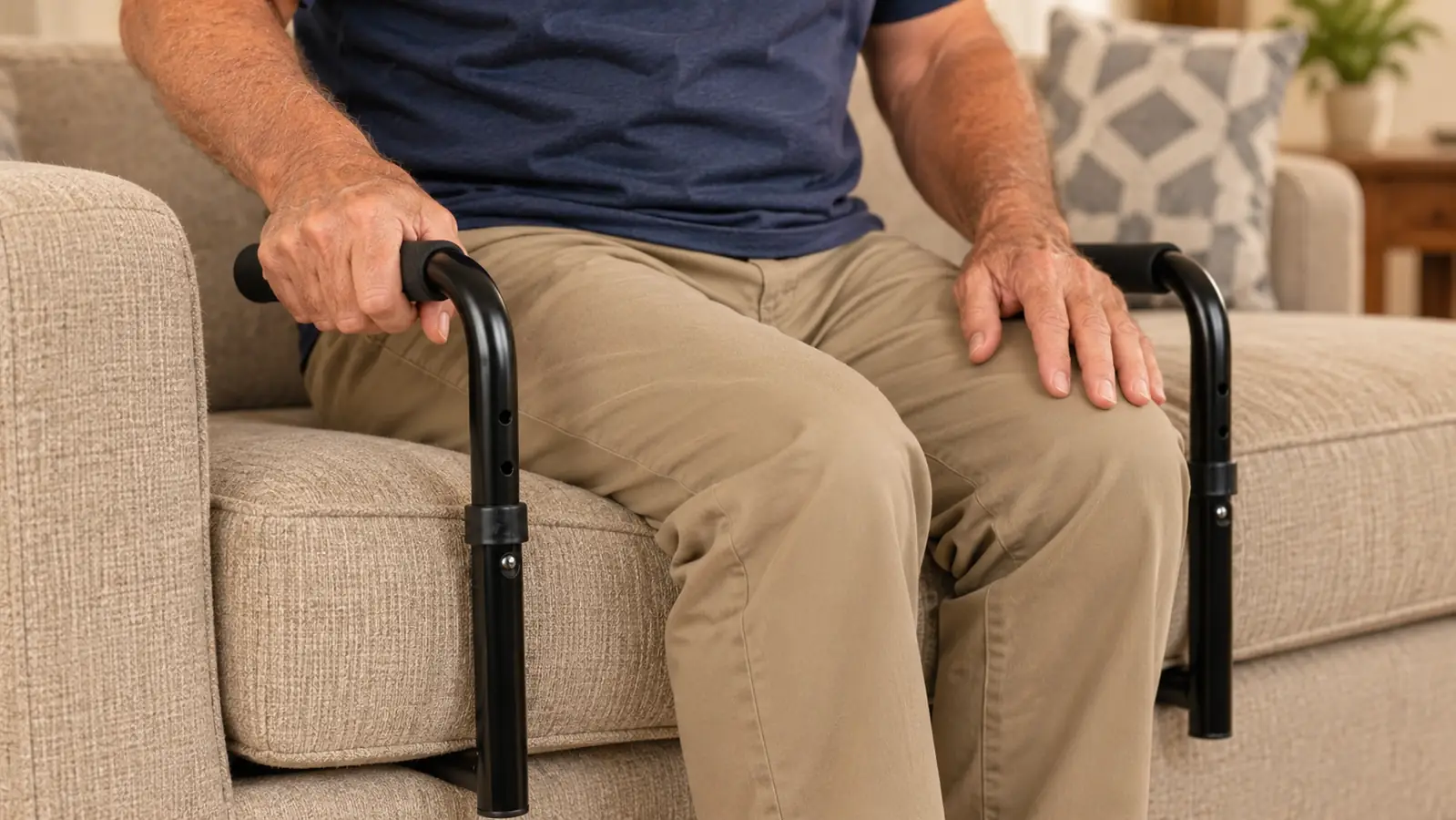
What follows is the sequence I taught clients, and where the Vive Stand Assist fits into it. It is a frame that tucks around the base of a seat cushion, or under a loose one, and gives you something fixed to push against. Vive builds it from aluminum and rates it to 300 pounds. It is not a lift chair and it will not stand you up by itself. It just gives your arms a job your knees cannot do yet.
The part of standing up that fails first is your hands, not your knees
The Vive Stand Assist slides around a seat cushion and gives you a fixed rail where the couch used to give way. Adjustable, portable from chair to chair, rated to 300 pounds, and it wipes clean with a damp cloth.
Amazon Check Today's Price on Amazon →Step 1: Measure the seat you actually sit on
Get a tape measure and press the cushion down with your hand right where your weight lands. Measure from the floor to the top of that compressed cushion. Anything under 17 inches is a low seat, and under 15 is the range where I have watched grown adults get stuck. Then measure your own lower leg, floor to the crease behind your knee. If the seat sits more than two inches below that number, you are not being lazy when you struggle. You are doing a squat that gym equipment was invented for.
While you are down there, check whether the couch moves. Push the front of it with one hand. A sofa that slides back across carpet is worse than a low sofa, because every ounce of effort you put into standing goes into moving furniture instead of moving you. Our living room is about 12 by 14 with carpet over a slab, and I finally put a rubber mat under the front feet after Ray walked the whole couch four inches toward the window over a winter.
There are two free fixes at this stage. Soft seats make this worse, because you sink in and lose the height you needed, so trade the mushy cushion for a firm one. A folded blanket under the cushion you already own will buy you an inch or two as well, and an inch matters more than people believe. The second fix is the couch itself. If it slides, stop it from sliding before you work on anything else.
Write the numbers down. Seat height, your lower leg measurement, whether the couch moves. When you go shopping for a chair, or when you are standing in a furniture store trying to decide if something is too low, having those numbers in your pocket turns a guess into a decision. I have measured more doorways and seat heights than I can count, and the number is always more honest than the feeling.
Step 2: Get your feet under you, then scoot
Most people who struggle to stand leave their feet out in front of them, heels six or eight inches from the couch, and then lean forward until their own shoes stop them. That is a losing position and no amount of effort fixes it. Your feet should be flat on the floor, about shoulder width apart, heels pulled back so your shins are close to vertical. On carpet, do this in shoes with a firm back. Socks slide, and a sliding heel turns a controlled stand into a fall.
Then walk your hips forward to the front edge of the cushion. Not a dramatic slide, just bring your weight over the part of the seat that is not going to give underneath you. Hands can help you scoot, but keep them on the frame or the arm, never on your knees. Pushing down on your own knees is a habit I have talked more people out of than any other, because it puts the whole load straight through the joint that is already angry.
There is one more thing to notice here. If your feet cannot reach the floor comfortably from that seat, stop and deal with that before you work on technique. My couch is fine for me at 5 foot 3 and terrible for Ray at 5 foot 11, because long legs want more room and he ends up with his knees higher than his hips. That is a furniture problem, not a discipline problem, and no amount of practice will fix it.
Step 3: Lean your nose past your toes
This is the cue I use, and it sounds silly until you try it once. Lean forward until your nose is further out than the tips of your shoes, then stand. If your nose stays behind your toes, your weight is still in the chair and the chair is going to win. The lean is a hinge at the hips, not a bend at the waist. Chest drops toward the floor, back stays flat, heels stay down.
Count it out loud if you have to. Nose, then push, then stand. Ray's three rocks are his version of this, and the reason the third one works is that by then his weight is finally far enough forward to be over his feet. The goal is to make the first rock the one that counts, which means leaning further and sooner than feels natural.
Do not add a twist. People who favor one knee will lean and then rotate to swing the bad leg out of the way, and that rotation is where backs go out. Keep your hips square to the front, stand straight up, and deal with the sore leg after you are already upright. If you truly cannot rise without twisting, that is information. It means you need something to push on, which is the next step.

Step 4: Push on something that does not move
Here is what nobody tells you about couch armrests. On most soft sofas the arm is foam over a frame attached to the same piece of furniture that is already sliding. You push down, the arm gives, the couch leans, and you get nothing for your trouble. The seat cushion is worse. A person in a hurry puts a hand on the cushion beside their hip and pushes, and that hand goes straight down into the void.
What you want is a fixed rail anchored at the frame of the seat. The Vive Stand Assist does exactly that. It tucks around the base of a secure cushion, or slips beneath a loose one, so the weight you put on it travels into the frame instead of into foam. It is roughly 22.25 inches wide and 12 inches high, weighs 2.7 pounds, and it is adjustable, so it moves from the couch to the recliner to a hard dining chair as needed. Vive rates it to 300 pounds and covers it with a lifetime guarantee.
Put it on the side of your stronger leg, and put it where you will not kick it walking past. In our house it lives on Ray's left, since the right knee is the new one and he likes to push with the left arm. Clean it with a damp cloth when it collects dust, which is the entire maintenance routine. One honest limit: it depends on a seat cushion to anchor against. On a hard bench with nothing to wrap around, this is the wrong tool, and a firm chair with arms is the better answer.
Set it up before you need it, not in the moment you are stuck. That means sitting down with a cup of coffee, working out where the rail wants to sit, and getting it right while your legs are fresh. A rail in the wrong spot is worse than no rail, because you will reach for it, find it off angle, and lose confidence in the whole idea.
The third rock works because by then his weight is finally over his feet. The whole trick is making the first rock the one that counts.
Step 5: Practice on your worst morning, not your best
The real test is the morning you wake up stiff. That is the morning to run the whole sequence slowly, out loud if that helps: feet under you, scoot to the edge, nose past the toes, push on the rail, stand. Do it four or five times while somebody else is in the house. Rehearsal is what makes the sequence automatic on the day your back is seized and you are not thinking clearly.
And here is the part I wish more families would hear. If you have done all of this and you still cannot get up, that is information, not failure. It means the couch is past what a rail and good technique can solve for you, and it is time to look at a chair that does the lifting. I have set up plenty of lift chairs for clients over the years, and the right time to buy one is before a fall, not after.
If a rail gets you standing but you are white-knuckling it, call that a maybe and reassess in a month. Bodies change quickly after surgery in both directions. What was impossible in week three is often ordinary by week ten, and what was easy in week ten can get harder again if you stop moving.
When a Rail Is Not Enough
A rail solves one problem. It gives you a fixed point to push from. It does not fix a seat that is too low, a knee that will not take weight, or balance that has gone. If you push down on the rail and your legs do not straighten, the rail has done its job and the answer is still a different chair. I would rather see somebody buy a lift chair a season too early than take a fall in their own living room at two in the morning.
The line I use with families is this. A rail is for a person who can stand with help. A lift chair is for a person who cannot get the first six inches. Those are two different problems and they need two different pieces of furniture, and a person can move between those categories in either direction over the course of a year.
What Else Helps
Footwear does more than people expect. A shoe with a firm heel and a thin, grippy sole keeps your foot from rolling and gives you a stable base to push from. Deep carpet and thick soft soles fight each other. I keep a plain pair of lace-up shoes beside the couch and Ray wears them indoors now, which he grumbled about for a week and then stopped mentioning.
Light matters more than it should. Standing up is a small athletic event and you want to see your feet while you do it. A lamp within reach of the couch, on a switch you can work without standing, is worth the trouble. So is a clear floor in front of the seat. A magazine rack, a pair of slippers, a cord across the carpet, any of those turns a good stand into a stumble.
And get the seat height right for the person who uses it most, which is not always the person who bought the furniture. In our house the recliner is set up for Ray and the couch is set up for me, and we stopped pretending one piece of furniture could serve us both. That single admission solved more trouble than any gadget I have brought through the front door.
Try the rail before you shop for the lift chair
The Vive Stand Assist anchors around a seat cushion, holds up to 300 pounds, and moves from the couch to the recliner when you need it to. It is the right first thing to try, and it will tell you plainly whether a rail is enough.
Amazon Check Today's Price on Amazon →