
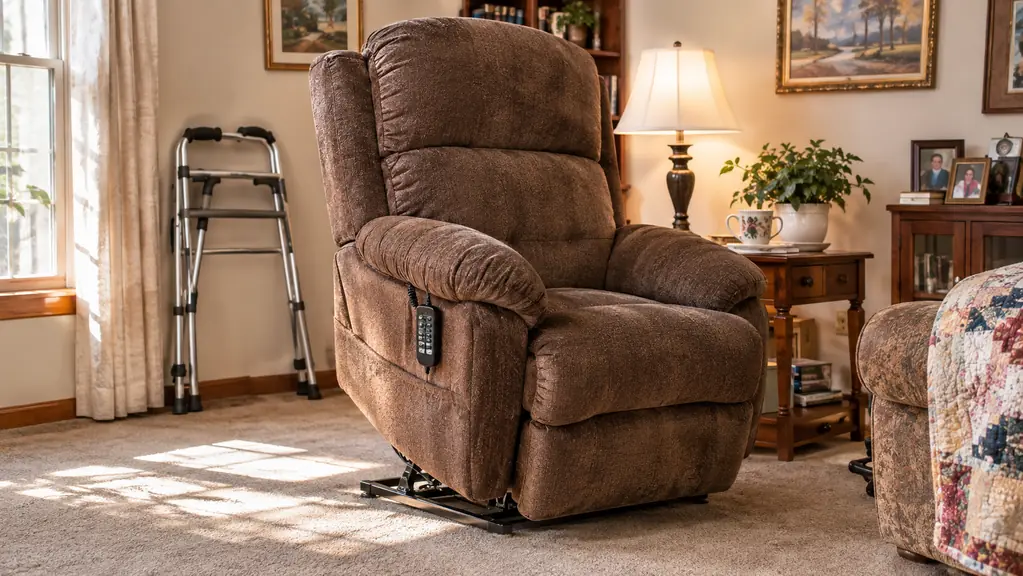
The box weighed 105 pounds and the delivery driver set it on my porch, said it was a two person job, and drove off. Nobody puts that part in the listing photos. The MCombo 7040 is a good chair for the job it was built to do, and I will get to all of that, but the honest version of this review starts two days before the chair was a chair: getting it inside, getting it put together, and finding out whether it would fit where we wanted it.
I am 68, and I spent 24 years as a home health aide, most of it in other people's living rooms, helping people stand up out of chairs that had quietly stopped being safe. My husband Ray is 73, a retired machinist with a knee replacement behind him, five foot eleven with broad shoulders, and he is the reason we bought a lift chair at all. We live in a single story brick ranch outside Knoxville. One living room, roughly 12 by 14 feet, carpet over a concrete slab, one outlet on the wall behind the recliners. That is the room this review comes from, and it is not a big room.
The Quick Verdict
A strong, steady lift chair for a grown man who needs help standing and will not be hauled up by the arms anymore. The lift is the reason to buy it. The size is the reason to measure first.
Amazon Check Today's Price →The Lift Is the Reason to Buy It. Check the Measurements Before You Do.
Ray stands up out of this chair on his own now, and that is worth more than any line on the box. Confirm the width against your doorway and the depth against your wall before you order.
Amazon Check Today's Price on Amazon →The First Two Days
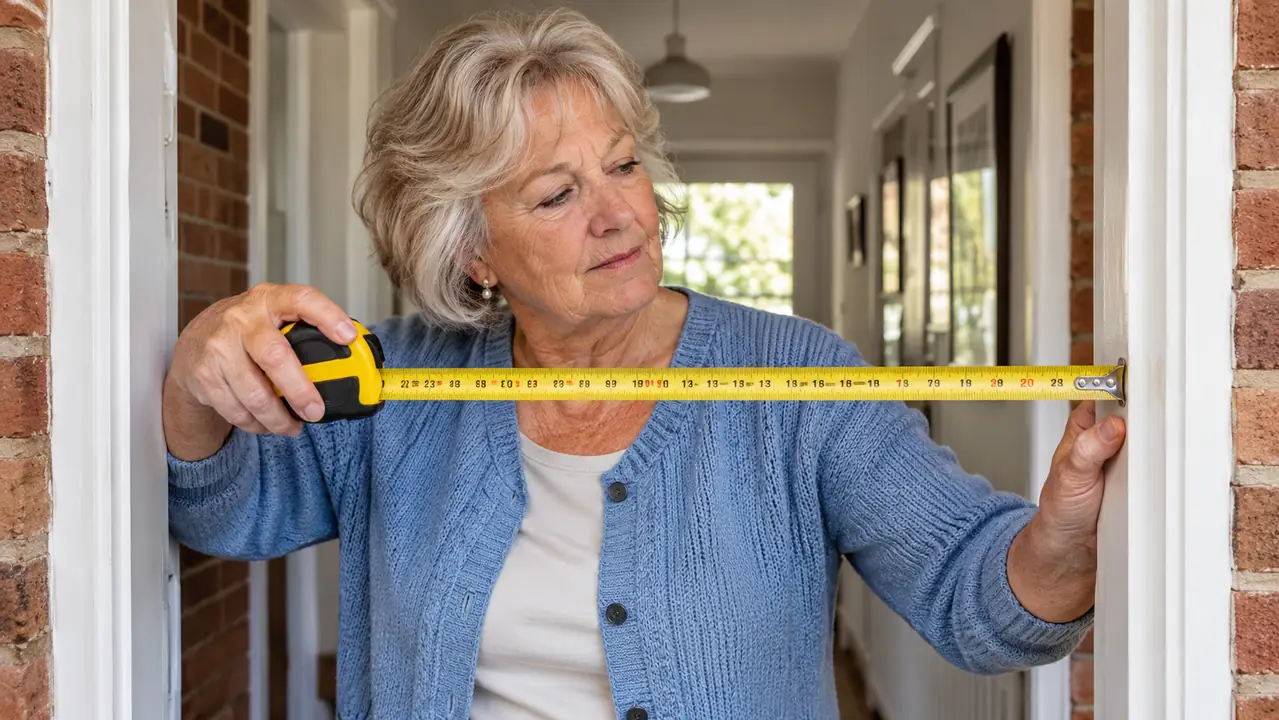
The chair does not arrive in one piece, which turned out to be the thing that saved us. It came as a backrest, two armrests and a base, with the hardware and the instruction manual in an accessories box. We carried it through the front door in sections, one at a time. Assembled, the chair is 35.2 inches wide and our door opening is 32 inches, so a fully built chair was never going through that doorway. If you are buying for a parent in an older house, that detail matters more than the upholstery does.
Assembly took Ray and me most of an afternoon with a break in the middle, and I am not going to pretend it was pleasant. The pieces are heavy and the base is the heaviest of them. One person can do it. One person with a bad back should not. Line up a neighbor or a grandson for the twenty minutes when the backrest goes on, because that is the part where you want a second set of hands, and a third would not hurt.
Then there is the room. A recliner needs space behind it to lay back, and our chair sits about a foot off the wall, which is tight when it goes all the way down. Our living room is a narrow rectangle with a coffee table in the middle and we had to move the table to the other side. I have seen more lift chairs sent back over the room they did not fit than over anything else, and I would rather tell you that now than have you find out with a 105 pound box on your porch.

What the Lift Actually Does
Ray uses the lift every morning to get up and every evening to go to bed, and in between he uses it to put his socks and shoes on, which sounds like a small thing until you have watched somebody hold their breath doing it from a low seat. The chair tilts him forward and up until his feet are flat and his knees are bent, and then he stands. That is the whole sequence. It is not dramatic. It is the difference between a good morning and a bad one.
Here is what nobody tells you, and I say it as someone who spent a career doing transfers by hand: the lift does not stand you up. It gets you to the edge of the seat, at a height where your own legs can finish the job. Ray can finish it. A person who cannot bear weight at all still cannot, and no chair on the market changes that. If you are shopping for somebody in that condition, you are looking at a transfer problem, and you should be talking to an occupational therapist before you talk to a furniture company.
What I can tell you is that the mechanism is honest. It is counter balanced, and the actuator is TUV certified, which is a line I would have skimmed past ten years ago and do not skim past now. Ray is a broad shouldered man and the chair does not strain under him. It does not sag or creep back down if he lets go of the button halfway up. If you have ever ridden a lift that slipped, you know why that was the first thing I checked and the reason I am still using this chair.
The Remote, the Heat and the Vibration
The remote has two lighted buttons for the lift and the recline, and I will defend those lights to anybody who calls them a gimmick. In a dim living room at nine at night, with a person whose eyes are not what they were, a button you can find without turning on a lamp is not a luxury. You hold the button until you are where you want to be and then you let go. There is no stored position to return to. The chair goes where you take it, which suits Ray fine and means I am the one who walks over and puts it back upright after he leaves it laid out.
The heat is one lumbar pad and it does one thing: it warms your lower back. It is not a sauna and it will not fix a disc. On a cold morning it loosens my stiff back enough that I can get moving, and that is the entire claim I will make for it. The vibration is eight points around the chair and it feels like the massager seat in a car. Ray likes it after a long day. I find it tiresome after ten minutes and switch it off. Neither function is why you buy this chair and neither is why you would skip it. They are extras, and they behave like extras.
The lift does not stand you up. It gets you to the edge of the seat with your feet under you, and then it is your legs that finish the job.
How It Has Held Up
The chair has been in the same corner for months now, running six or eight times a day between the two of us, and nothing has loosened. The base sits flat on carpet over concrete and it has not walked or shifted an inch. When Ray pushes up out of it, the chair takes the push instead of scooting, and that is not a small thing on a hard floor. The padding under his shoulders has not flattened out and the seat still has its shape.
I have one maintenance note and it comes out of my aide years rather than out of this chair. Dust collects in the seam where the back meets the seat, and a lift chair is harder to vacuum than a sofa because you cannot tip it up on its end. Run a vacuum crevice tool along that seam once a month. It takes two minutes and it keeps the mechanism area from collecting grit.
The outlet is the other thing, and it is a real one. Ours is behind the chair and low to the floor, and getting to it means moving furniture that weighs 105 pounds. Put a short extension or a power strip somewhere a person can reach without crawling, and do it before the chair goes into the corner, not after. That is not a flaw in the chair. It is a flaw in how most of us set these things up.
What It Replaced
The chair it replaced was a plain manual recliner, the kind with a handle on the side and a footrest that snapped up. Ray liked that chair for twenty years and then one winter he could not get out of it without a hand. That is how it goes. It is not one bad day, it is a slow winter. What I noticed after the switch is that he stopped avoiding the chair. For a while there he was sitting on the edge of the sofa instead, because it was easier to stand up from, and a man who will not sit in his own recliner is a man shrinking his world one room at a time.
So if you are weighing a lift chair against a plain recliner, the difference is the lift, and it is not a small difference. Everything else is roughly the same experience. You still get a big chair that lays back, you still give up the floor space, you still argue over who sits in it. What you gain is the standing up. If standing up is not the problem, save your money and buy a comfortable recliner. If standing up is the problem, nothing else in that room solves it.
Things I Would Change
The chair is labeled Medium and it is cut for a bigger frame than mine. I am five foot three, and when the back is fully upright my feet do not sit flat on the floor. I put a cushion behind me and it fixed the problem for nothing, but a shorter person should know that going in, because a chair that leaves your feet dangling is a chair you will quietly stop using. If you are under five foot four, sit in one before you buy if there is any way on earth to do it.
The heat being one spot instead of a whole back panel is the second thing. On a bad day I want the entire lower back warm and I get one patch of it. The third thing is not the chair's fault: the recline goes back far enough that Ray falls asleep in it most afternoons, which means I have to wake a 73 year old man for dinner and take the blame for it. That is my entire complaint list. It is short, and none of it is a reason not to buy.
One thing did surprise me. I expected a lift chair to read as medical equipment sitting in the middle of a living room, and it does not. It reads as a big recliner. Guests sit in it without asking what it is. Ray's brother came over, sat down, and never noticed the remote on the arm until Ray picked it up and raised the chair with him in it. That matters more than I expected, because a chair that announces itself as sickroom equipment is a chair a proud man will find a reason not to use.
What I Liked
- Counter balanced lift with a TUV certified actuator moves smoothly and holds its position when you let go
- Two lighted remote buttons you can find and read in a dark room without turning on a lamp
- Sits flat and stable on carpet over concrete and does not scoot when you push up out of it
- Ships as separate pieces, so it goes through a 32 inch door that the assembled chair would never clear
- Eight vibration points and a lumbar heat pad, both simple to run and easy to switch off
- Reads as ordinary furniture, which is why a self conscious person will actually keep using it
Where It Falls Short
- 35.2 inches wide once assembled, so plan the doorway and the wall before you order
- No stored position. You hold the button the whole way up or down
- Heat is one lumbar spot rather than a full back panel
- Medium sizing runs large for a five foot three user without a cushion behind the back
- Needs a reachable outlet, and in most rooms that outlet is behind 105 pounds of chair
Notes for the Caregiver
If you are the one shopping, and the chair is for a parent who has not asked for one, two things from my working years. First, do not frame it as safety equipment. Frame it as a better chair. The word lift makes some people dig in, and a proud person will refuse a device long before they will refuse a comfortable place to sit. Second, set it up before they see it. A box in the hallway is a decision they have to make. A chair in the corner is just furniture that showed up.
And watch how they get out of the chair they have now before you buy anything. Not how they say they get out. Watch. If they push off the arms, if they rock for momentum, if it takes two tries, you are looking at the right purchase. If they slide forward and stand with one hand on a walker, a lift chair still helps, but go slower and get the size right, because a chair that puts them too high or too low to stand safely is worse than the one they already own.
Who This Is For
This chair is for a person who can still stand with a little help and wants the chair to do the helping, and for the caregiver who is tired of being the help. It suits a taller, heavier person better than a small one. It suits a house where somebody has measured the doorway and left room behind the chair for it to lay back. If Ray is the measure, a man with a replaced knee, a stiff morning, and enough pride to hate being pulled up by the arms, the MCombo 7040 does exactly what it promises and asks nothing of him but a thumb on a button. Thousands of reviews on that listing say much the same thing, and after living with it I understand why.
Who Should Skip It
Skip it if the person cannot bear weight. The lift is an assist, not a hoist, and buying this for somebody who needs a true transfer is how people get hurt in hallways. Skip it if the doorway is narrow and nobody is around to help carry the pieces in. Skip it if the living room is so tight that a full recline blocks the walkway to the kitchen, because a chair you have to climb past is a chair that becomes a nuisance. And skip it if the only thing wrong with the current chair is that it is old, because this is a lot of chair to buy for that. MCombo labels this one Medium, which tells you there are other sizes, so if the medium is too much chair for a small frame, look at the smaller one before you give up on the design.
If He Still Has to Be Pulled Up by the Arms, This Is the Fix.
The lift is steady under a grown man, the buttons light up in the dark, and the chair passes as furniture instead of equipment. Measure the door, measure the wall, then look at the current price.
Amazon Check Today's Price on Amazon →