

Getting out of a chair should not be a project. For a lot of people past seventy it is: hands on the armrests, a rock forward, a second try, and a small negotiation with gravity before they are finally upright. I watched that struggle for twenty-four years as a home health aide, most of it in other people's living rooms, helping someone make the transfer from chair to walker without a fall. The problem is almost never willpower. It is the seat. Too low, too soft, too deep, and built for somebody twenty years younger.
Families try everything short of a new chair. A firmer cushion. A strap around the armrest. Phone books under the seat. A dining chair dragged in from the kitchen, which is worse than what they had because it has no arms at all. None of it fixes the thing that is actually wrong. A power lift recliner does, because it changes the geometry instead of asking the knees to compensate. The one I ended up living with is the MCombo 7040, a medium power lift recliner, and it sits in a twelve by fourteen living room on carpet over a concrete slab. Here is the order I would do this in if I were starting over.
If standing up is the hard part, start with the chair that stands up for you
The MCombo 7040 is a medium power lift recliner with a counter-balanced lift mechanism and a TUV certified actuator. Two lighted buttons on the remote run the lift and the recline. It measures 35.2 inches wide, 35.8 inches deep and 44.5 inches high, and it weighs 105 pounds, so read Step 1 before you order anything.
Amazon Check Today's Price on Amazon →Step 1: Measure the room, the doorway, and the floor
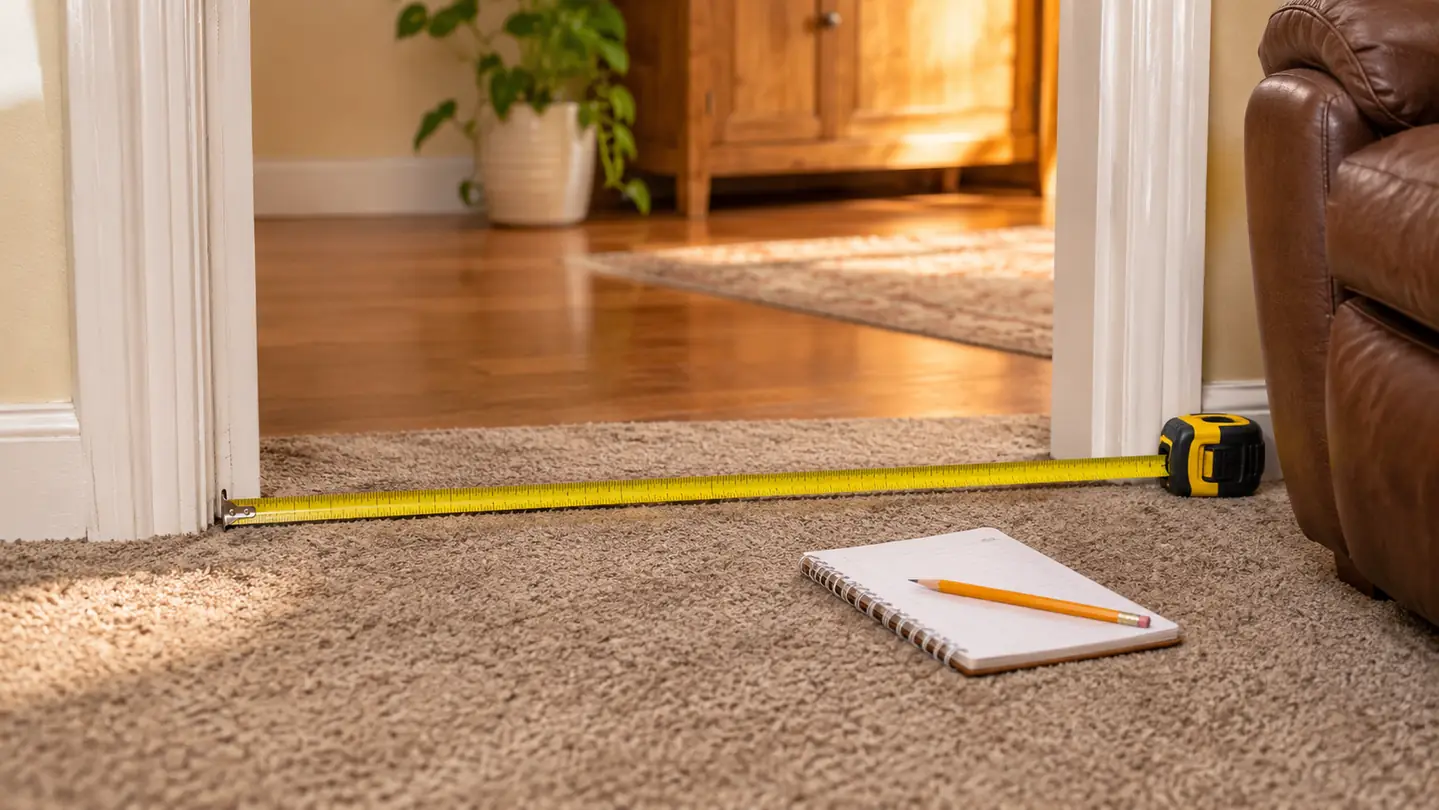
I measure before I recommend anything. Not because I love tape measures, but because I have watched a family buy a chair that would not go through the front door, and I have watched a chair arrive and then sit in a garage for three weeks while everybody argued about it. Write down three numbers: the width of every doorway the chair has to pass through, the wall space where it will live, and how far the nearest outlet is from that spot.
The MCombo 7040 is 35.2 inches wide, 35.8 inches deep and 44.5 inches high. My front door is 32 inches wide, which means this chair does not go through it standing up. It has to be tipped and turned, or it comes in through a garage or a slider instead. That is not a reason to avoid it. It is a reason to know it before the delivery truck is in the driveway. The chair also leans back, so whatever is behind it cannot be a wall you need to walk past every day.
Two more things I check. First, the floor. At 105 pounds, on carpet over a concrete slab, this chair stays put when someone pushes down on the arms to rise, which is exactly what you want. On bare hardwood it is a different story, and a rug underneath helps. Second, the outlet. Mine is behind the chair, so the chair has to sit a few inches off the wall to leave room for the plug and the cord. Measure that gap now instead of discovering it after the chair is in place and the cord is stretched tight.

Step 2: Match the seat height to the person, not to the room
Seat height is the number that decides whether this works. Not the back height, not the overall height. The seat height: floor to the top of the cushion where a person actually sits. The rough target is the back of the knee, so the feet rest flat and the hips are level with the knees or a touch above them. My husband Ray is five foot eleven and broad through the shoulders. I am five foot three with a lower back that stays stiff until about ten in the morning. The same chair has to work for both of us, and it does, but only because we checked before it was delivered.
Ask the seller for the seat height in writing and compare it to the measurement you took at home with shoes on. If the seat is too low, you have bought a chair that still needs a rock forward to escape, and the lift becomes the only way out of it. If it is too high, the feet dangle and the back of the thigh takes all the pressure. A recliner that is three inches off for one person is three inches off every single day for years.
Seat depth matters too, and it is the one people forget. You want two or three fingers of space between the back of the knee and the front edge of the seat. When the seat is too deep, the person slides forward to keep their feet down, and then they are perched on the front edge, which is the exact position that makes standing up hardest. If you are shopping in person, bring the tape measure. If you are shopping online, measure the chair you already own and measure the person sitting in it.
Step 3: Understand what the lift actually does
A lift chair is not a recliner with a motor bolted on the bottom. The lift mechanism on the 7040 is counter-balanced and runs on a TUV certified actuator, and it pushes the whole chair up and forward, tipping the seat until the person is more standing than sitting. That is the point of it. It is not a slow elevator. It changes the angle so the knees and hips are already partway through the motion before the person adds any effort of their own.
Control is a remote with two lighted buttons, one for the lift and one for the recline. I want to be plain about why the lighted part matters to me. Most of the falls I saw in clients' homes happened at night, on the way to the bathroom, when somebody was half awake and reaching for something they could not see. A button that glows is a small thing that keeps a person from fumbling in the dark and then deciding to stand up anyway.
Test the lift with the person actually in the chair, feet flat and pulled slightly back, before you decide to keep it. Some people want to be carried almost all the way to standing. Others want a nudge only, and they will bring the chair partway up, plant their feet and finish the job themselves. Both are fine. What you do not want is a chair that tips so far that the person loses contact with the seat and has to catch themselves on the way down. Go slow the first several times, with somebody standing next to them.
Step 4: Judge the extras honestly
The 7040 has eight vibrating points around the chair and one heating point at the lumbar. I run the heat in the evening when my back has tightened up from a long day of sitting. Ray uses the vibration when his knee is aching and he does not want to take anything for it. Both are comfort features. Neither is treatment, and I would not let a salesperson tell you otherwise. Vibration is a steady buzz. Heat is warmth. They feel good, and they keep a person in the chair long enough to actually rest, which is worth something on its own.
The high back is the other feature I would pay attention to. A high back supports the shoulders and gives the head somewhere to go when the chair is reclined, and for a person who is thin, or who has lost weight this year, that support is the difference between a real nap and a neckache. What I would not do is buy a chair for the extras. Buy it for the lift and the fit. If the extras come along with it, good.
Step 5: Sit in it the way you will actually use it
Sit in it for an hour before you decide, not five minutes. Bring the book you are reading, the phone, the television remote, the glass of water. A chair that feels fine for five minutes can be a misery at forty, and the things that make it a misery are small: an armrest that hits the wrong spot, a remote with nowhere to live, a recline that stops at an angle you do not want to sit at.
Then do the part that actually matters. Get in and out of it ten times in a row, the way a real day works. Once from fully reclined. Once in a hurry. Once in the dark with your hand finding the button by feel. If the chair has to come all the way upright before the person can get out, that is something to know before you buy it, not after.
And check how it moves. A 105 pound chair on carpet is movable by one strong person and miserable for everybody else. If you need to shift it to vacuum underneath, plan on two people and lift rather than drag. If it is going in a bedroom instead of a living room, measure the turning room at the foot of the bed, because a lift chair needs clearance in front of it as well as behind.
The chair is 35.2 inches wide and my front door is 32. That is the first thing I check now, because it is the thing almost nobody checks.
What Else Helps
A lift chair is the biggest single fix, and it is not the only one. If the person spends the morning in one chair and the evening in another, that second chair matters just as much. A firm cushion under a sagging seat. A chair with arms sturdy enough to push against. A side table within reach so nobody has to twist around for a glass of water. Those are cheap, and they work.
Lighting is the other thing I would fix the same week. I have never understood why people put a recliner in a corner with the lamp on the far wall. Put a lamp or a switch within arm's reach of the chair, and put a phone there too. A person who does not have to get up to answer the phone is a person taking fewer risks in a day.
And if you are weighing a lift chair against something smaller, like a riser cushion or a portable lift, be honest about which one the person will actually use every single day. A cushion that gets pushed to the back of the closet has helped nobody. If you want the deeper detail on one specific model, there is a long-term writeup on this site on the MCombo 7040, and a separate piece on lift chairs versus other options for seniors. Take the measurements here first, then read those with real numbers in hand.
Measure the doorway first. Then order the MCombo 7040
35.2 inches wide, 35.8 inches deep, 44.5 inches high, 105 pounds. A counter-balanced lift on a TUV certified actuator, two lighted buttons on the remote, eight vibrating points and a lumbar heating point. It is the chair Ray reaches for when his knee is stiff, and it is the one I would measure for first.
Amazon Check Today's Price on Amazon →