

The part nobody photographs is the doorway. Before the CANMOV lift recliner came into our house, I did what I have always done with a big piece of furniture: I measured the front door, then I measured the chair, then I stood in the yard and thought about it. Our door is 32 inches wide. The chair is 39 inches across. That is not a small gap, and it is the first thing worth knowing.
I am Loretta Ainsworth. I am 68, I live outside Knoxville, and I spent 24 years as a home health aide helping people get up out of chairs and beds. My husband Ray is 73, a retired machinist, a couple of years past a knee replacement, and he is the reason we own a lift chair at all. This is not the listing read back to you in a nicer voice. It is what I found living with the CANMOV every day, including the parts I would change.
The Quick Verdict
A roomy, well-padded lift chair that solves the standing-up problem for a broad man, as long as you measure your door and your floor before you order.
Amazon Check Today's Price →A 21 Inch Seat and a 27 Inch Back, for a Man Who Fills Both
Ray is 5 foot 11 with broad shoulders and he stopped sitting on the edge of this one. Check the current price and the full spec sheet, then go measure your doorway. Both numbers matter.
Amazon Check Today's Price on Amazon →How We Have Actually Used It
The chair sits where our old recliner sat, in a living room about 12 by 14 feet, on carpet over a concrete slab, with one wall outlet behind it. Ray uses the lift more than anyone. He comes in from the kitchen, sits, watches forty minutes of television, and then pushes the button to stand instead of rocking himself forward. I use the recline side in the evenings because my lower back stiffens up and a chair that leans back is more forgiving than one that does not.
The first week was mostly me watching him. He would sit down and then look at the remote like it owed him money. By the fourth day he had it worked out, and by the second week he had stopped announcing that he was about to stand up, which is how I knew the chair had done its job. He had stopped thinking about standing at all, and a man who is not thinking about standing is a man who is watching the ballgame.
What I did not expect was how much the seat width would change the way he sits. The seat is 21 inches wide. Ray is 5 foot 11 and broad through the shoulders, and on our old chair he perched forward on the edge, braced, like a man waiting for a bus. On this one he sits back. That sounds like a small thing. It is not. A man who sits back in a chair is a man who is no longer using his arms to hold himself up.
The backrest is 27 inches, extended, per the listing. Ray's head rests against it without a pillow wedged behind his neck, which was a nightly complaint with the old chair. I am 5 foot 3 and I will be plain about this: the chair is too big for me. My feet do reach the floor at the front edge, but I rattle around in it, and after an hour my hips feel like they have been sitting in a church pew. This is a big and tall chair. I am neither.
The Measurements Are the Whole Story
The listing gives 38 inches deep, 39 inches wide, 43 inches high, and 100 pounds. Read those as a floor plan rather than a description. Ours sits with roughly two inches to spare on the side where the lamp is, and I had to move the lamp. The weight matters too. A hundred pounds resting on carpet over a slab is fine. A hundred pounds you have decided to shift by yourself, up a step, in a hurry, is not.
We measured on a Sunday morning with a metal tape and a pencil, and I wrote the numbers on the back of an envelope: front door 32, hallway turn a shade over 40, wall where it sits 44. The hallway number was the one that saved us, because the chair came through the front on its side and had to pivot at that corner. The delivery men were patient about it. I was not. But we got it in, and I have no regrets about the envelope.
One line in the listing that people skim straight past: the surface recommendation is hard floor. Ours is on carpet. It has been perfectly fine there, but the chair does not glide and it is not meant to. It is a chair you position once and leave. If you have deep pile or a thick rug pad under it, expect it to plant itself even more firmly. If you were hoping to push it around the room to follow the afternoon sun, this is not that chair.
And the door. Thirty-nine inches of chair does not pass through a 32 inch opening. Whether the back comes off on yours is a question for the seller, and it is worth asking before the delivery truck is in your driveway rather than after. Measure the front door, measure the turn in the hallway, and measure the spot where it will live. I have watched three families get this wrong over the years, and every one of them ended up with a chair in a garage.
The Lift Function, Honestly
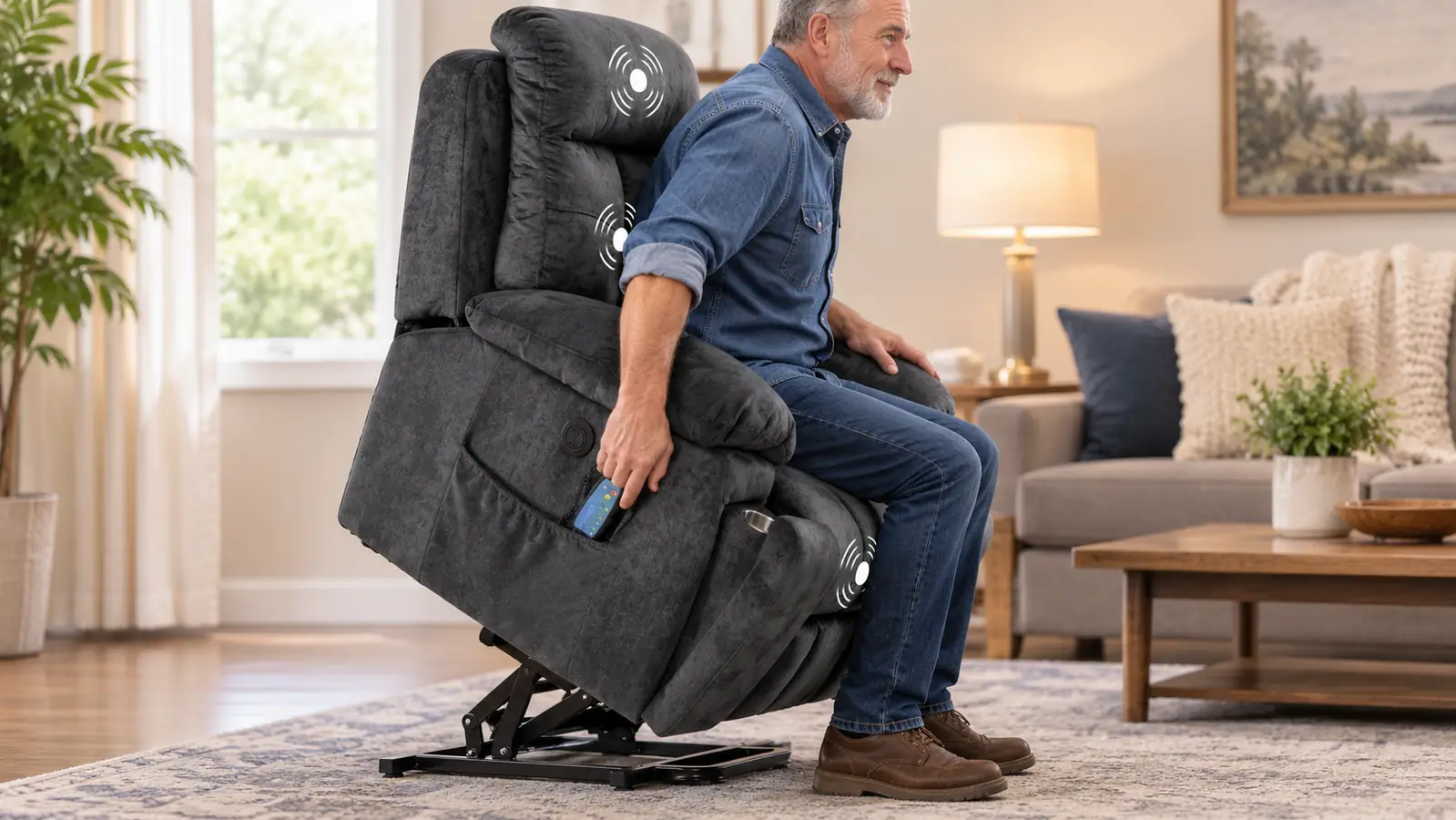
The lift runs off a button, and the remote is included. Ray presses it, the seat tilts him forward and up, and he stands. He does not push off the armrests. He does not rock. He does not do the thing he used to do where he would get halfway up, lose his nerve, and sit back down and pretend that had been the plan all along.
He does not do the thing he used to do where he would get halfway up, lose his nerve, and sit back down and pretend that had been the plan all along.
The honest caveat is speed. The lift is not fast, and it is not supposed to be. There is a rhythm to it: press, wait, stand. If you are the sort of person who expects to be launched out of the chair, you will find it slow and you will say so. If you are the sort of person who has been quietly afraid of falling in your own living room, slow is the entire point and you will not mind it at all.
I timed it once, out of plain curiosity, with the clock on the stove. Seated to standing is somewhere in the neighborhood of ten to fifteen seconds depending on how far back he has the chair reclined, and Ray has never once grumbled about that number. What he did grumble about, in the first weeks, was the first inch of the lift, that moment where you feel tipped forward before your feet are properly under you. By the end of the month he had stopped noticing it. I would rather tell you now than have you find out on your own and wonder whether something is wrong with the CANMOV.
One more thing about the lift, and here I sound like the aide I used to be. A lift chair does not replace a walker and it does not replace balance. It puts a person on their feet. What happens in the two seconds after that is still their knees and their equilibrium. I have seen people treat the lift button like a guarantee and then be startled when the room kept moving. It is a tool, not a spotter.
Massage and Heat: What It Is and What It Is Not
The chair has massage and heat, a remote, five massage modes, and eight massage points. I want to be careful here, because this is the part of the listing that sells hardest and delivers most ambiguously. It is not a massage chair. It is a recliner with massage points built into the padding. You feel it as moving pressure through the upholstery rather than as a pair of hands working a knot out of your shoulder blade.
Ray uses it on a low setting after he has been on his feet, mostly across the lower back. I use it less. On the stronger settings it is more than I want, and there is no shame in admitting that. Think of it as a warm, moving cushion rather than as therapy. It is pleasant. It is not the reason to buy the chair, and if the massage were removed tomorrow I would not miss it much.
Here is the honest test I ran. On a Tuesday in February I came in from the mailbox with my lower back locked up, sat down, put the heat on and the massage on the lowest setting, and stayed there for half an hour with the television off. I got up warmer and looser than I went down. I did not get up fixed. If that distinction matters to you, then you and I are on the same page about what this feature is worth.
The heat is the part I would keep if I could only keep one. Warmth on a stiff back in the evening is worth something real, especially in a Tennessee January when the house never quite warms up. But it is localized and it is gentle. If you are expecting a heating pad you can crank until it burns, this is not that either. It is a comfort feature, and it behaves like one.

The Small Things That Turned Out to Matter
The USB charging port. I rolled my eyes at that line in the listing and then I used it every single day. Ray's phone lives on the arm of that chair. One wall outlet behind the recliners is all our living room has, and now the phone charges where he sits instead of from a cord stretched across the floor where I would eventually trip on it in the dark.
The cup holders are hidden in the arms. Ray keeps a glass of water in one and the remote in the other, which means the remote has stopped migrating into the couch cushions and being blamed on me. There is a side pocket as well, and it holds a magazine, a pair of reading glasses, and whatever else he refuses to set on a table like a normal person.
The covering is a short plush and the care instructions say wipe clean. That has held up better than I expected. It is soft to the hand and, more importantly, it does not grab at clothing when you slide forward to get up, which is the sort of thing that matters to a person with a bad hip and no patience. The frame is FSC-certified wood, the fill is cotton, foam and sponge, and the backrest and armrests adjust. I care more that the frame is wood than that it is certified, but both are in the listing and the chair does not creak after a few months of daily use, which is the test I actually apply.
The Things I Would Change
It is heavy and it stays put. That is the same fact I just praised as a strength and it cuts the other way too. When I want to vacuum underneath it, I want a second person. When Ray wants it angled toward the television, it angles by reclining. It is not a chair you re-aim by shoving. It is a chair you place once and build the room around.
It is also, honestly, too much chair for a small person. I said this earlier and I will say it again because it is the single most common mismatch I see in other people's houses. A woman of 5 foot 3 with a bad back buys the big and tall model because it looks more supportive, and then she cannot settle into it properly and her knees ache by supper. If that is you, buy the standard size. The 21 inch seat is a gift to a broad man and a nuisance to a narrow woman.
And the massage. If I were ordering again, I would rather have a simpler chair with better heat than a chair with five modes we do not use. That is my preference and I know it is not everyone's. Ray is indifferent to the whole feature. We have it either way, and I would not want anyone reading this to buy the chair for the massage and then feel let down by it.
What I Liked
- The 21 inch seat and 27 inch backrest genuinely fit a broad, tall man, and Ray stopped perching on the edge
- The lift is steady and unhurried, which is exactly what a person who fears falling wants
- The USB port, hidden cup holders and side pocket earn their keep every single day
- Wood frame, no creaking after months of daily use, and the short plush wipes clean
- Moves a 5 foot 11 man from seated to standing without him pushing off the armrests
Where It Falls Short
- 100 pounds and 39 inches wide: measure the door and the room before you order, not after
- The listing recommends a hard floor, so on carpet it plants itself and stays there
- The massage is moving pressure through the padding, not a massage chair
- Too roomy for a small person; at 5 foot 3 I rattle around in it
- The lift is slow by design, and it is no substitute for balance or a walker
Who This Is For
This chair is for a big man who has trouble standing up and who has been making do. If the person you are shopping for is close to 6 foot or broad through the shoulders, or if you have watched them sit forward on the edge of a chair and push themselves up with both hands, this is worth a hard look. Ray is 5 foot 11 and broad, and the 21 inch seat changed how he sits, not just how he stands, which I did not see coming.
It is also for a household with a corner to park it in and 39 inches of wall to give it, and for the person a few weeks out from a knee replacement, the way Ray was, who needs the chair to do the standing rather than asking the new knee to do it. If you are the grown child doing the shopping for a parent, the CANMOV is the model I would put on the short list for a large father and take straight off the list for a small mother.
Who Should Skip It
Skip it if you are small. Under about 5 foot 6 and narrow through the shoulders, this chair is more room than you need, and a standard lift recliner will fit you better besides. Skip it if your doorway is tight and there is nobody around to help you get the thing inside. Skip it if you want furniture you can move around the room, because this is not that.
And skip it if what you actually need is a hospital bed, a proper rail, or an assessment from an occupational therapist who can see your house and your hips in person. A lift chair is furniture. A good piece of furniture, in this case, but it will not do a job it was not built for, and no button on a remote changes that.
If the Measurements Fit Your House, This Chair Will Fit Your Husband
39 inches wide, 100 pounds, a hard floor recommendation, and a lift that puts a grown man on his feet without a fight. Take the tape measure to the doorframe first, then go look at today's price.
Amazon See the Current Price on Amazon →