

Ray is 5 foot 11 with broad shoulders, and for two years after his knee replacement the hardest part of his day was not walking. It was standing up. He would rock forward twice, push down on the arms of a low recliner, and sit back down on the third try like he had changed his mind. I spent 24 years as a home health aide helping people out of chairs exactly like that one, so I assumed I already knew what to buy him. I was wrong twice before the CANMOV Power Lift Recliner came through the front door.
This is not a first week impression. The chair has been in our living room for months now, sat in daily, lifted up and down more times than I could count, used by a man close to the top of the size range it was built for and by a woman at the bottom of it. What follows is what held up, what annoyed us, and who I would steer away from it. If you are shopping for a parent or a spouse and you want the honest version rather than the listing photos, this is that.
The Quick Verdict
A genuinely big chair that lifts a heavy man out of the seat without drama. The massage and heat are pleasant extras, not the reason to buy. Buy it for the size and the lift, and measure your doorway first.
Amazon Check Today's Price →The lift does the standing up. He just leans back.
The one function that never got old after months of daily use. Check the current price and compare the dimensions to your room before you commit.
Amazon Check Today's Price on Amazon →How I've Used It
The chair sits in the corner of our living room, on carpet over a concrete slab, with one wall outlet behind it. Ray uses it every evening and most afternoons. He is the one who runs the lift, because he is the one who has trouble standing. I sit in it in the mornings when my lower back is stiff, and I am 5 foot 3, so I am close to the opposite end of the size range from him. That split turned out to be useful. It let me see how the chair behaves for the person it was designed around and for the smaller person who ends up using it as a plain recliner.
I did not run lab tests and I am not going to pretend I did. I did what I did in clients' homes for 24 years. I watched how he got in and out, whether his feet reached the floor, whether the chair shifted when it lifted, and whether anything started to creak, lean or sag once the novelty wore off. I kept a tape measure on the side table the whole first week, because the most common mistake I saw in other people's houses was a chair that fit the person and did not fit the room.
Before the CANMOV we went through two others. The first was a standard recliner with a 19 inch seat that looked fine in the showroom and was wrong the moment he sat down. Ray sank into it and had to be pulled forward by the elbows. The second was a lift chair, but the seat was narrower than his shoulders and he sat on the edges of it rather than in it. Both went back. By the time the CANMOV arrived I had started writing seat width on an index card and holding it up against every listing before I ordered.
One thing I will say up front. This review covers the size and the mechanics. It is not medical advice, and a lift chair is not a treatment for anything. It is a piece of furniture that takes the hardest part of standing up off a pair of sore knees. That is a real help and it is not a cure.
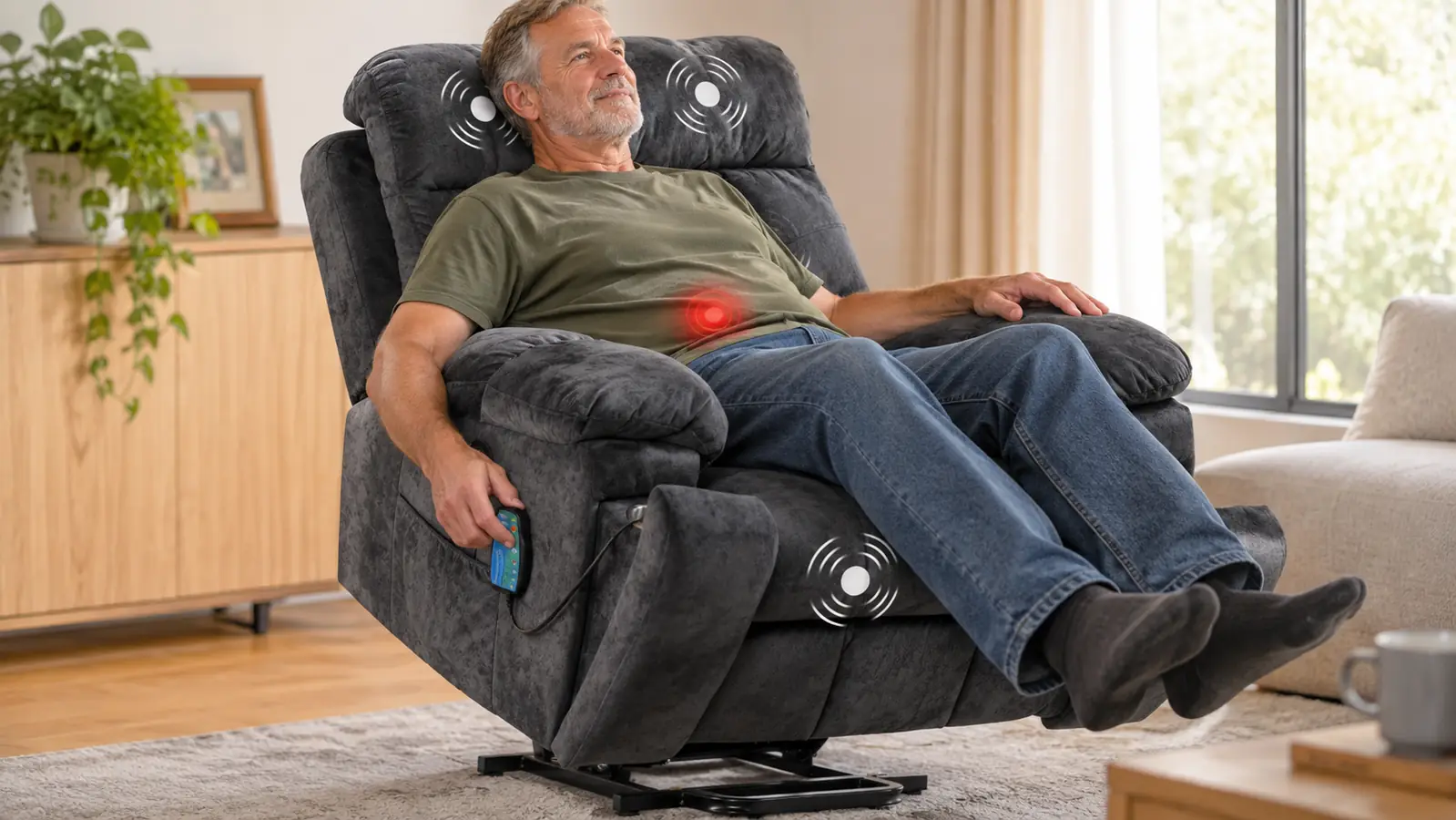
What 27 Inches of Backrest and a 21 Inch Seat Actually Feel Like
The two numbers that matter most here are the 27 inch extended backrest and the 21 inch widened seat. A standard recliner seat runs closer to 19 or 20 inches across, and a standard backrest is shorter. Four extra inches of seat width does not sound like much on paper. In practice it is the difference between a man with broad shoulders sitting inside the chair and a man sitting on top of it with his arms pinned to his sides. CANMOV lists those numbers plainly, which I appreciated, because most listings bury them.
The 27 inch backrest is what lets Ray put his head back without his shoulders riding up over the top edge. On our old recliner his head cleared the backrest and there was nothing behind his neck at all. Here his whole upper body is supported, and that matters more than people expect when someone sits for two or three hours at a stretch. I noticed it first in how he stopped shifting around after the first hour. He was not adjusting the chair. He was adjusting himself to a chair that was too small.
For me the same chair is simply large. At 5 foot 3 I sit with room on both sides and my feet still reach the floor when the chair is upright, which is the thing I care about most in any seat. I do not like a chair where my legs dangle. The 38 inch overall depth means there is real room to stretch out, and it also means a small person will feel like they are sitting in a big chair, because they are. That is the tradeoff of a big and tall build and there is no way around it.
The Lift Function After Months of Daily Use
The lift is the reason to buy this chair and it is the part I watched most closely. It runs on the remote at the push of a button, rises smoothly, and stops where you let go. Ray is a heavy man. The chair does not shudder, does not scoot across the carpet, and does not make him feel like he is being tipped forward out of a chute. He leans back slightly, the seat carries him up, and he stands from a height closer to standing than to sitting. That is the whole trick and it works.
After months of daily use the motor sounds the same as it did in week one. Nothing has loosened. The frame is FSC certified wood, and while I cannot inspect what I cannot see, the chair has not developed the lean or the wobble that usually shows up in a cheap recliner by the third month. The 100 pound weight is part of why. Heavy furniture tends to stay where you put it, and this one does.
Here is the test that convinced me. Back in February Ray came in from the driveway with his knee swollen and stiff, the kind of afternoon where he does not want to be helped and does not want to be watched either. He sat down, pressed the button, and stood up on the first try without rocking. A year earlier that same afternoon would have ended with me standing in front of him with both hands out. I did not say anything. I did not have to.
Two honest notes. The listing recommends hard flooring, and we have carpet over a slab. It has been stable for us, but on a thick pile or a deep rug I would want a mat underneath, especially during the lift, when a lighter chair can walk backwards an inch at a time. And the lift is not fast. That is not a fault. A slow lift is what you want when somebody is holding on with both hands.
He stopped rocking forward three times to stand up. That was the whole point, and it happened in the first week.
Massage, Heat and the Remote Nobody Reads the Manual For
The chair comes with a remote, five massage modes and eight massage points, plus heat. I want to be straight with you about how much that matters. It is pleasant. Ray uses it maybe twice a week, usually in the evening when his back is tight. It is not the reason this chair works and it would not be the reason to pay more for a chair. The lift is the reason. If you are choosing between two chairs and one has more massage settings, that is not the deciding factor.
The heat takes a few minutes to come through the short plush, so do not expect warmth the second you press the button. The eight massage points run down the back and into the seat. Ray uses the same mode every single time and ignores the other four. I have run a full cycle myself maybe a dozen times in all these months. It is pleasant, it is forgettable, and I would not pay extra for a chair that offered more of it.
The remote itself is the part that surprised me. I have watched a lot of older adults give up on a chair because the controls were small, backlit in the wrong way, or needed a manual nobody could find. This one is a wired remote with clearly separated buttons, and Ray worked it out in an afternoon without being taught. It lives in the side pocket when he is not using it. The cup holders are hidden in the arms, which sounds like a small thing until you have watched someone balance a glass on a knee.
The USB charging port on the side is one of those details that turns out to matter more than the massage. His phone charges in the chair now instead of on the kitchen counter, and that means he is not getting up every twenty minutes to check it. The short plush fabric wipes clean, which I have already tested with a cup of coffee and a wet cloth. I would not call any of this luxury. I would call it thought through.
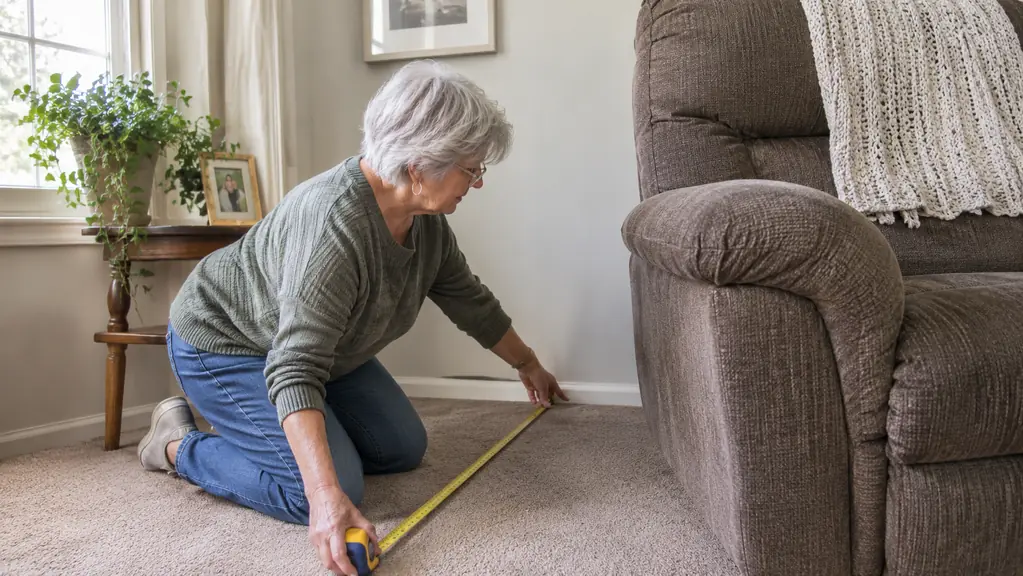
Fitting a 100 Pound Chair Into a 12 by 14 Foot Living Room
Our living room is roughly 12 by 14 feet, which is not large. The chair is 39 inches wide, 38 inches deep and 43 inches high, and it went where the old recliner had been without rearranging a single thing. The front door is 32 inches wide, and this is the part that should worry you. A 39 inch wide chair does not pass through a 32 inch door in one piece and it does not turn a tight corner either. Ours came in partly disassembled, which is how most of these ship, and it still took two of us.
Before you order, measure three things. The doorway the chair has to pass through, standing open, with the door off its hinges if it comes to that. The wall space you plan to give it. And the distance from the back of the chair to the wall behind it when it is fully reclined. That last number is the one people forget. A chair that reclines into the middle of the room is fine. A chair that reclines into a coffee table is a daily irritation that never goes away.
I also took the 43 inch height into account, because our chair sits in front of a window and anything taller would have blocked the light we get in the afternoon. I laid a tape on the carpet from the back of the seat to the baseboard and got about 8 inches of clearance, which lets this one recline without touching. If you have less than that, you will be dragging the chair forward every evening and shoving it back before bed.
One more thing from 24 years of walking into other people's houses. Put it near an outlet. The chair needs power for the lift, and a cord stretched across a walking path is a trip hazard, especially at night. We had one outlet behind the recliner already in the right place. If yours is not, sort that out before delivery day rather than after.
What I Liked
- 27 inch backrest and 21 inch seat genuinely fit a broad, tall man
- Lift rises smoothly, stops where you release it, no shudder and no drift
- Wired remote with clear, separated buttons, worked out in an afternoon
- Hidden cup holders, side pocket and a USB charging port that gets used daily
- Stable after months of daily use, no lean, no creak, motor sounds unchanged
- Short plush fabric wipes clean with a damp cloth
Where It Falls Short
- 100 pounds, so plan the delivery and the doorway before it arrives
- Listing recommends hard flooring, so thick carpet may need a mat underneath
- Massage and heat are pleasant but not the reason to buy this chair
- A small person will feel swallowed by a 21 inch seat
- It takes wall space and recline clearance, and there is no way around that
Who This Is For
This chair is for a tall or broad person who struggles to stand from a low seat, and for the family member sensible enough to measure the doorway before ordering. It suits a man around 5 foot 10 to 6 foot 2 with wide shoulders, a bad knee, a stiff back, or a hip that has been replaced. It also suits the grown son or daughter doing the shopping, because the lift takes the thing they worry about most, the fall, and turns it into a slow controlled rise with a hand on the armrest. If you are buying for a parent and the standing up is the problem, this is the category of chair I would look at first.
Who Should Skip It
Skip it if the person using it is small. At 5 foot 3 I can sit in this chair, but it was not built for me, and a 5 foot or 110 pound parent will rattle around in a 21 inch seat with a 27 inch backrest. Skip it if the hallway or bedroom door it must pass through is narrower than about 34 inches and the chair has to go through assembled. Skip it if you are buying for looks, because a 100 pound chair announces itself. And skip it if the only thing you need is a place to sit. A plain recliner does that job, and this one earns its keep on the lift, not on the upholstery.
Measure the doorway first, then decide. The chair will still be here.
Months in, the lift is the reason we kept it. Check today's price and hold the 39 inch width and the recline clearance against your room.
Amazon Check Today's Price on Amazon →