

The first lift chair I helped choose was for a woman who could not have weighed more than a hundred pounds, and that recliner swallowed her whole. Her feet hung above the floor. When the lift ran, it tipped her forward before her shoes were under her, and she grabbed at my arm every time. The chair was not defective. It had been built for a body twenty pounds heavier and four inches taller, and nobody had checked the numbers before it was delivered.
Most lift chairs are sized around an average frame, so a small person ends up with a seat that is too deep, a footrest that catches her at mid calf, and a lift that throws her forward before she is ready for it. If the person you are shopping for is 5 foot 4 or under, or has short legs relative to her torso, this is the whole game. The MCombo 7141 in the small size is the chair I would start with for that body. What follows is the order I would set it up in, in a real living room, on real carpet, with one wall outlet behind the chair.
Petite sizing comes down to three numbers
Seat height, seat width, and how deep the seat sits. The small MCombo 7141 is built for a shorter frame, and the listing carries the current dimensions and today's price so you can compare before anything is delivered.
Amazon Check Today's Price on Amazon →Step 1: Measure the person before you measure the chair
Do this in the shoes she wears around the house, not in stocking feet. Sit her on a firm dining chair with her feet flat and her back against the backrest. Measure from the floor to the crease behind her knee, right where the leg bends. That number is the seat height you are hunting for, give or take an inch. If the chair's seat sits much higher than that, her feet will dangle, and dangling feet make a lift chair far harder to stand from than a chair that is slightly too low.
Then measure across her hips at the widest point while she is seated, and add two inches. That is roughly the seat width she needs before the armrests start pressing into her. A chair that is too narrow is uncomfortable, but a chair that is too wide is worse for a small person, because she slides sideways when she leans forward to stand. You want her held in the seat, not loose in it. If she uses a walker or a cane, measure her with it nearby, since she will be reaching for it as she rises.
Last, watch how far she has to lean forward to get her weight over her feet. If she has a stiff lower back, or a knee that does not bend far, write that down. It tells you how much of the lift she will actually use. Some people only need the first two inches of the rise and can do the rest themselves. Others need the chair to do most of the work. That difference changes how you set everything up, and it is why two people with the same waist size can need different chairs.
Step 2: Measure the doorway, the carpet and the wall
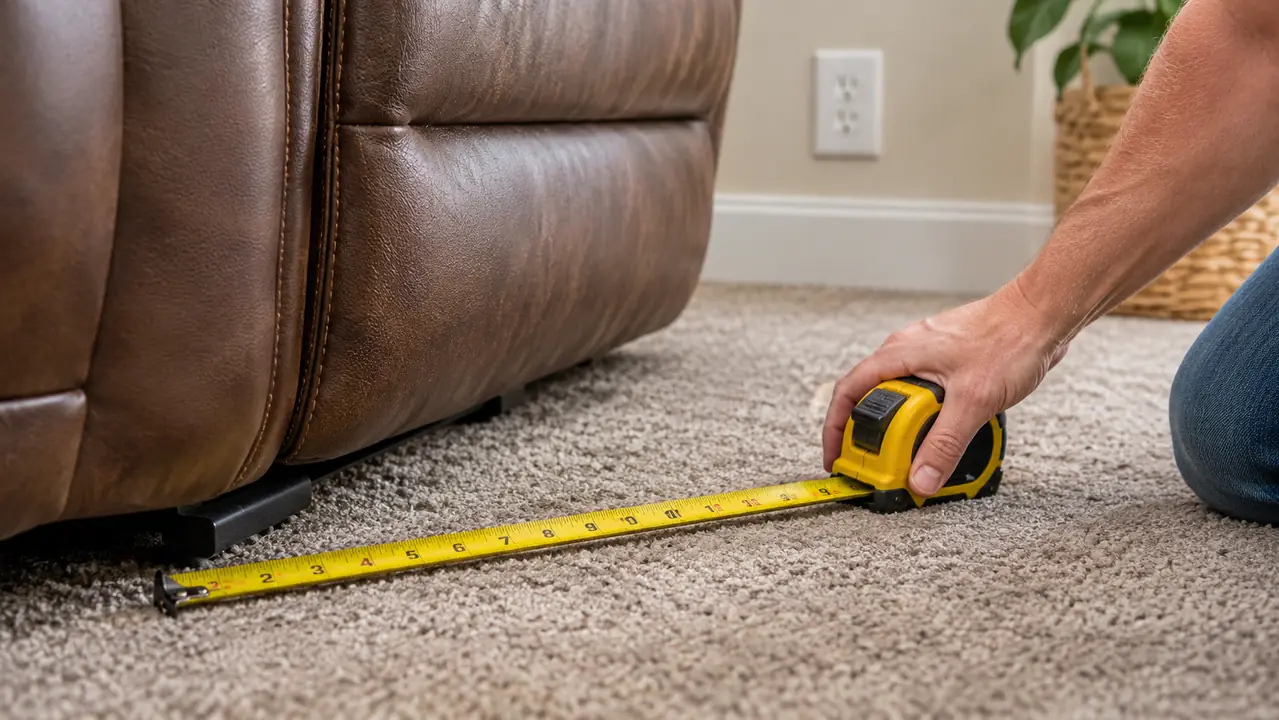
My front door is 32 inches wide. The small 7141 is 32.7 inches wide overall, so it does not roll through that door in one piece, and it is not meant to. It arrives in parts and goes together in the room where it will live. Clear the path from the door to the living room first. The chair weighs 121.3 pounds assembled, and nobody wants to drag that across new carpet or try to turn it in a hallway with a linen closet on one side.
Measure the wall space next. The chair is 32.7 inches wide, 35.79 inches deep and 42.1 inches high, so give yourself a little air on each side, away from baseboard heat and away from any door that swings into the spot. Leave room behind the backrest for the recline. A recliner that touches the wall on the way back will stop short of flat, and the person using it will feel that every single evening without ever knowing why the chair does not go back the way the one in the store did.
The listing recommends carpet, which is what I have in my living room, a low pile over a concrete slab. Carpet holds the base still when the lift runs. On bare hardwood, put a thin rug or gripper pads under the corners so the chair does not walk when the mechanism pushes up and back. Also confirm the outlet before delivery day. My one wall outlet sits behind the chair, which is fine as long as the cord is not pinched under the base and the plug can be reached without moving furniture.
Step 3: Set the seat height and footrest to her legs, not to the catalog
Compare the seat height on the listing to the measurement behind her knee. You want her feet flat on the floor, not on tiptoe and not swinging. If the seat runs an inch or two high, a firm cushion can close the gap without turning the whole chair into a marshmallow. If the seat sits low, no cushion will fix it and every stand will be a struggle. This is the one measurement I will not guess at. Ask the seller for the seat height from the top of the cushion to the floor, then compare it to her number.
Then set the footrest. On a power recliner the footrest comes up before the back goes down, and a petite person often ends up with her heels on the footrest and her knees locked straight, which is a miserable position to get out of. Run the recline only as far as her knees stay softly bent. The backrest adjusts on its own, so you can put the back where she is comfortable and keep the legs where they belong, instead of dropping the whole chair into one position and calling it done.
The high back matters here too. A small person in a tall-backed chair can end up with her head pushed forward by a pillow that was made for a longer torso. If that happens, take the extra pillow out. Use the chair's own backrest and add a small roll at the lower back only if she asks for one. And check her heels against the footrest with the chair fully reclined. If her heels float, she will slide down the seat over twenty minutes and wake up in a heap at the bottom of the chair.
Step 4: Practice the stand in stages, with the lift stopping early
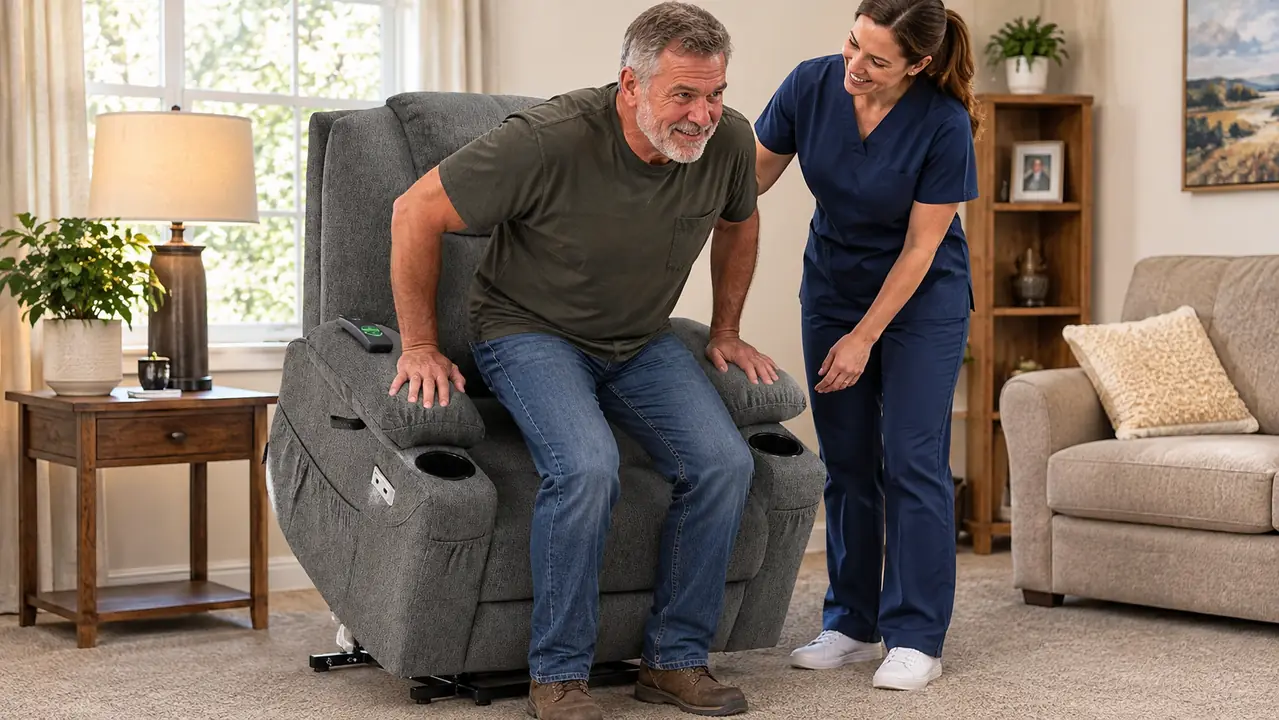
Do not let anybody use the full lift on the first day. Sit her down, have her scoot her hips back until her back touches the backrest, and put both feet flat and slightly apart. Hands on the armrests, not on your shoulders. Then run the lift and stop it when her thighs have cleared the seat, with her feet still flat on the floor. That is the point where standing becomes a small step instead of a heave, and it is usually much earlier in the rise than people expect.
If she can stand from that stopped position, good. She may not need the rest of the rise at all. If she cannot, run the lift another inch or two, stop, and try again. What you are looking for is the lowest position where she can come to her feet under her own power. Remember that setting. Write it on a sticky note on the side table if that helps, because a caregiver on a Tuesday morning will not remember it either.
Stand to the side, near her stronger arm, not in front of her. Standing in front gives her something to pull on, and pulling on a person is how caregivers hurt their backs and how seniors lose their balance. If she needs a hand, offer a forearm and let her push down on it while the chair does the lifting. When she is seated again, watch that she does not drop the last few inches. The control should be released slowly, not let go, so the chair settles instead of thumping.
Step 5: Set the heat and vibration to a short, repeatable routine
The 7141 has lumbar heat and eight vibration nodes with three massage modes and three intensity levels. Set it up as a routine instead of leaving everything running. In my experience the heat is the part people use daily, and the vibration gets used for ten or fifteen minutes after a walk or before bed. If the person has an implanted device or a skin issue, that is a question for her doctor, not for me and not for the product listing.
The cup holder in the armrest and the loop beside it keep a drink and the controls from sliding down between the cushion and the wall. Small thing, but I have watched more than one person try to fish a hand control out from behind a recliner with a grabber. Show her where the loop is on the first day. The chair also carries a two year warranty, so keep the paperwork and the accessories box in a drawer instead of the attic, and keep the cord where nobody steps over it in the dark.
A petite person does not need a smaller lift. She needs a chair whose seat height puts her feet flat on the floor before the mechanism starts tipping her forward.
What Else Helps
A firm cushion, one to two inches thick, is the cheapest way to fine-tune a seat that runs slightly high. Skip the soft foam. Soft foam compresses into a hole and puts her right back where she started, and it makes the seat edge harder to slide off. A small lumbar roll helps if the high back leaves a gap at the small of her back. A side table within reach saves her from twisting to set down a cup, which is exactly the motion that causes trouble in the first place.
Put a lamp or a night light near the chair so she is not standing up in the dark, and keep a phone within arm's reach. If the lift ever stops partway, the chair can be brought back down with the same control, so make sure she knows which button does what before you leave the room. Recheck the fit after a month. Carpets settle, cushions flatten, and a chair that fit in March can feel different by May, especially if she has gained or lost weight after surgery.
If the small size still feels roomy, that is useful information rather than a failure. MCombo builds this chair in more than one size, and moving to a different size is a better answer than stacking pillows until she is sitting on a pile. The right fit is boring. She sits down, she stands up, and nobody thinks about the chair at all. If anyone in the house is still noticing the chair after two weeks, go back to the measurements and find the number that is off.
Fit the chair to her, not the other way around
Measure the seat height, clear the path, and set the lift to stop where her feet are flat. The small MCombo 7141 gives a shorter frame a real starting point, and the current dimensions are on the listing.
Amazon Check Today's Price on Amazon →